


 Since 1986, AJEM has published an estimated 2,000 peer-reviewed research papers from Australia, New Zealand and around the world.
This growing body of knowledge has documented the tremendous expansion in emergency management planning and policy, the growth in rigour in academia and practice, the transfer of research within the sector and the adoption and testing of improved approaches to much of how we plan, respond and renew after disaster events.
In its 40th year of publication, AJEM is publishing reflections from readers around the world to recall their favourite and most influential paper(s).
Associate Professor Melissa Parsons
University of New England
AJEM Editor-in-Chief
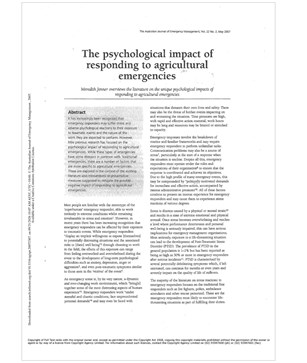
The psychological impact of responding to agricultural emergencies
By Meredith Jenner
Volume 22(2): 25-31, 2007
https://search.informit.org/doi/pdf/10.3316/agispt.20072387
Submitted by Nathalie Brown
Victorian Department of Energy, Environment and Climate Action (DEECA)
Why is this paper significant to you and why has it held your attention?
I found this paper the first I had read about the impact of agricultural emergencies. We speak about the impact of emergencies on firefighters and to the community, but the agricultural aspect wasn't as obvious. I was working with Agriculture Victoria (within the Department of Natural Resources and Environment) from 2000-2010 and there were so many impacts to our staff.
How has this paper influenced your work? Or, how has this paper had a significant influence in this area of emergency management?
I was able to use this learning to help prepare staff for emergency response. I circulated to many of my regional colleagues, specifically the livestock teams. It helped ensure that during the 2009 fires we had Employee Assistance Program councillors on site at every morning and afternoon briefing to discuss how staff were going, offering tips and eventually spending time with a few highly impacted staff. It is possibly the catalyst for my focus on supporting the supporters years later, improving how DEECA (formerly DELWP) looked after the recovery wellbeing of their staff.
Beyond 2026, what's next in this field of research or practice that builds on this paper?
With emergencies becoming more frequent and severe, I think it is critical that we continue to look at new ways to look after our emergency responders, including during the recovery phase, to ensure that they are not traumatised and there is growth in the way we do things.
The epistemological non-sense of disaster studies and some more sensible prospects
By JC Gaillard
Volume 15(2):8–14, 2000
Submitted by Mark Trudinger
Northland Civil Defence Emergency Management Group, Northland Regional Council, New Zealand
Why is this paper significant to you and why has it held your attention?
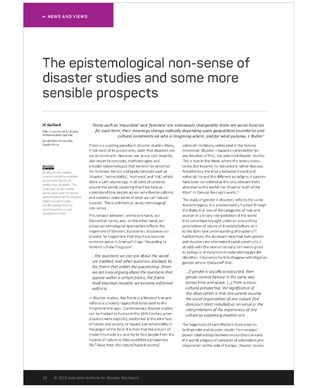
This paper stands as a landmark in disaster studies, primarily in terms of questioning the very epistemology of the field, the dominance of Western hegemony and the importance of people who are affected by disasters, especially those 'at the margins'.
How has this paper influenced your work? Or, how has this paper had a significant influence in this area of emergency management?
As someone who is profoundly interested in the intersection of theory, practice, and guidance (or ideas, praxis, and co-research), this paper challenged – and continues to challenge – my thinking and practice. The paper should have had a far greater influence on emergency management than it has – the fact that it hasn't is not a reflection on the paper, but on the very issues with both the disaster studies and emergency management fields, that the paper explores.
Beyond 2026, what's next in this field of research or practice that builds on this paper?
Both research and practice could benefit from being more widely exposed to the disaster studies Manifesto and the Accord – 2 documents that are foundational for, in turn, understanding JC's paper from AJEM. Overall, both research and practice need to put communities first - not bureaucracies, methodologies, theories, and programs from on high.
The Manifesto and Accord are available here:
https://www.radixonline.org/manifesto-accord
The influence of organisational culture on learning lessons: implementing a lessons management life cycle
By Lisa Marie Jackson
Volume 31(1): 18-23, 2016
Submitted by Russell Buzby
Captain, NSW Rural Fire Service (RFS)
Why is this paper significant to you and why has it held your attention?
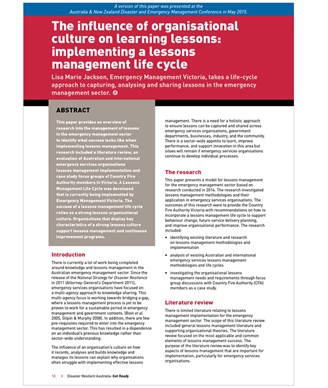
I came to it from two directions at once. I am a volunteer with a rural brigade in southern New South Wales, where I run training, and I spend my working life on organisational change in the Commonwealth. Jackson's paper is the only thing I have read that speaks to both without translating between them. Her conclusion is that the lessons management life cycle works where a lessons culture already exists, and stalls where it does not. That is an uncomfortable finding, because it says the process is not the intervention. It has held my attention for a decade because every organisation I have worked in since has proved her right, and none of them wanted to hear it.
How has this paper influenced your work? Or, how has this paper had a significant influence in this area of emergency management?
It changed what I do after an incident, and it changed what I sell. At brigade level I stopped treating the debrief as the lesson. A debrief produces material; whether anything becomes a lesson depends on what the brigade does with it over the following season, and whether the people who were there believe it is safe to say what actually happened. In consulting, it made me ask a question I did not used to ask: before designing a process that produces lessons, can this organisation hold one? Where the answer is no, a better template makes things worse, because it manufactures evidence of learning that nobody has done.
Beyond 2026, what's next in this field of research or practice that builds on this paper?
Two lines already run from it. Medbury, Brooks and Coole (2021) argue that lessons sit on a vertical stratum and fail when pitched at the wrong level of work, and Glassey (2025) asks whether artificial intelligence can dissolve the documentation and silo problems that stop lessons landing. Both are agency shaped. What neither addresses – and what I would like to see – is lessons management in a volunteer organisation, where the culture that Jackson identifies as decisive belongs to a brigade of a few dozen people rather than to the agency above them. Cole and colleagues found in 2018 that post-event inquiry recommendations very rarely address volunteers at all. If the culture is where lessons live, and most of the people are volunteers, then most of the research is looking at the wrong stratum.