Introduction
Societies internationally are recognising the urgent need for radical transformation in our relationships with nature. Our natural world is changing rapidly and increasing severity and frequency of disasters are affecting communities globally. Evidence and insights from Australia and around the world highlight the critical role of nature in supporting spiritual, emotional, physical and psychosocial recovery after disasters.
The Australian-first Nature-led Community Resilience (NLCR) Toolkit (Lee et al. 2024a) and Story Library (Lee et al. 2024b), draws on the reciprocal connecting and healing of people and nature in recovering from disasters, incorporating nature-based initiatives into disaster resilience. It reinforces community values and leadership capabilities, fostering community participation through volunteering and enhancing local understanding of disaster risks and resilience-building measures for nature. It supports communities to identify, understand, and take meaningful, informed and collaborative action in realising their responsibility as custodians of local natural environments.
A nature and community-led approach to disaster resilience
Activities that enable more effective and sustainable disaster recovery for humans and nature are increasingly being sought by disaster managers, environmental organisations and community groups. NLCR has an important role to play to support disaster recovery and resilience activities, by helping people and nature recover together and build resilience in disasters. This is because disasters can impact people in many and varied ways: physically, financially and psychosocially (e.g., fear, loss, change) (Quinn et al. 2021).
The impact of disasters on nature can also cause trauma to people through a sense of loss of their familiar natural environment and surroundings and agency and control in how they connect with it. Changes in nature not only affect the local community but are far more wide-reaching, because these changes can affect people from far away, even people who have never been to the impacted area. This means that nature recovery, too, can have wide-reaching benefits (Block et al. 2019).
Disasters can have devastating impacts on nature, impacting biodiversity, threatened species, ecosystems and critical habitats (IPCC 2022). Healthy environments and ecosystems are essential to supporting human health and wellbeing (Martin et al. 2020). Supporting and prioritising nature in disasters is therefore critical to supporting community recovery.
What is nature-led community resilience?
NLCR is connecting people with nature to support nature’s recovery, and in doing so people are supported in their own recovery and hope for the future. NLCR recognises the symbiotic and reciprocal relationship between people and nature. It involves people healing nature and nature healing people (see Figure 1).
NLCR also galvanises efforts to support nature, and longer-term shifts supporting actions caring for nature within and outside a disaster context. This matters because communities with connection, direction and purpose recover more readily than others (Aldrich 2012).
The role of nature in healing is increasingly backed up by evidence and practice (Block et al. 2019; Porter et al. 2023). As more people in Australia are impacted directly or indirectly by the escalating disaster landscape, we look for new ways to cope with climate change and its impact on people and our environment.
The idea of NLCR is not new. For millennia, First Nations Peoples have embodied a way of being that encompasses Caring for Country, Healing Country and Walking Together. Integral to the idea of Caring for Country is that nature needs people, and people need nature, and that people have a responsibility to manage Country (Weir et al. 2011).
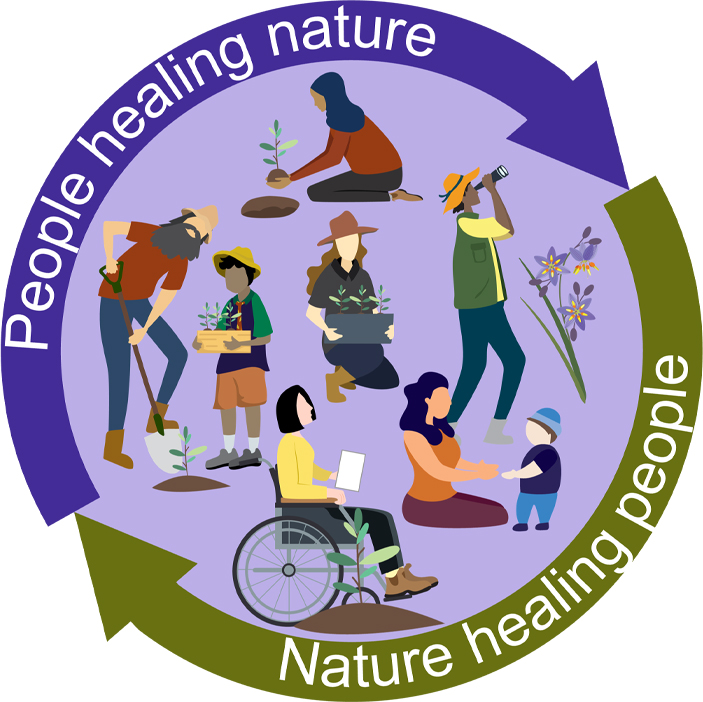
Figure 1: Nature-led community resilience reflects the reciprocal relationship between people and nature.
Source: Lee et al. 2024b.
Many Indigenous and other cultures conceptualise humans and nature as forming a single balanced and symbiotic relationship. They view humans and nature as connected, not separate entities (West et al. 2020); many people see their wellbeing and identities deriving from their relationships with both people and nature (Chan et al. 2016; Quinn et al 2022). These ideas of reciprocity, interconnectedness and responsibility for Country provide important foundations for a nature-led community resilience approach.
NLCR approach benefits people and nature
NLCR aims to genuinely and meaningfully engage local communities in nature connection and support human recovery. It is informed by, and enables, the basic elements of psychosocial support in disasters (Hobfoll et al. 2007). These are: generating a sense of physical safety and promoting calm; enabling connection with others and the environment; supporting agency through self and collective efficacy; and instilling hope.
NLCR supports the recovery and resilience of both human communities and natural ecosystems, drawing on globally recognised disaster recovery and resilience principles and trauma-informed practices, alongside local biodiversity recovery needs (see toolkit for more details). NLCR activities focus on decision-making, community engagement, resourcing, working on ground and strategic learning. NLCR actions should be readily included in disaster-end environmental recovery and resilience programs to support impacted communities through connection to, and care for, regenerating nature.
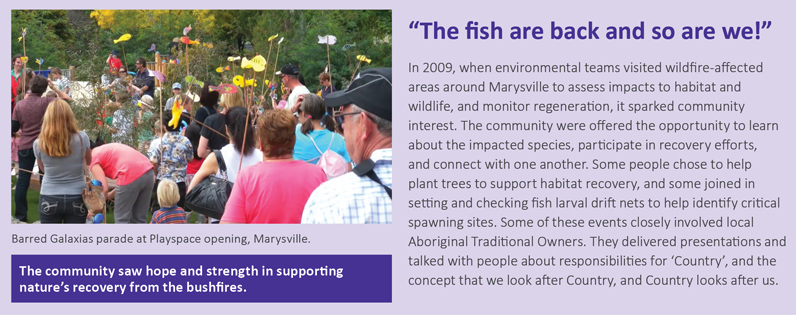
The beginnings of NLCR as featured in the NLCR Story Library (Lee et al. 2024b). Image: Fern Hames.
Incorporating NLCR during the different phases of disasters
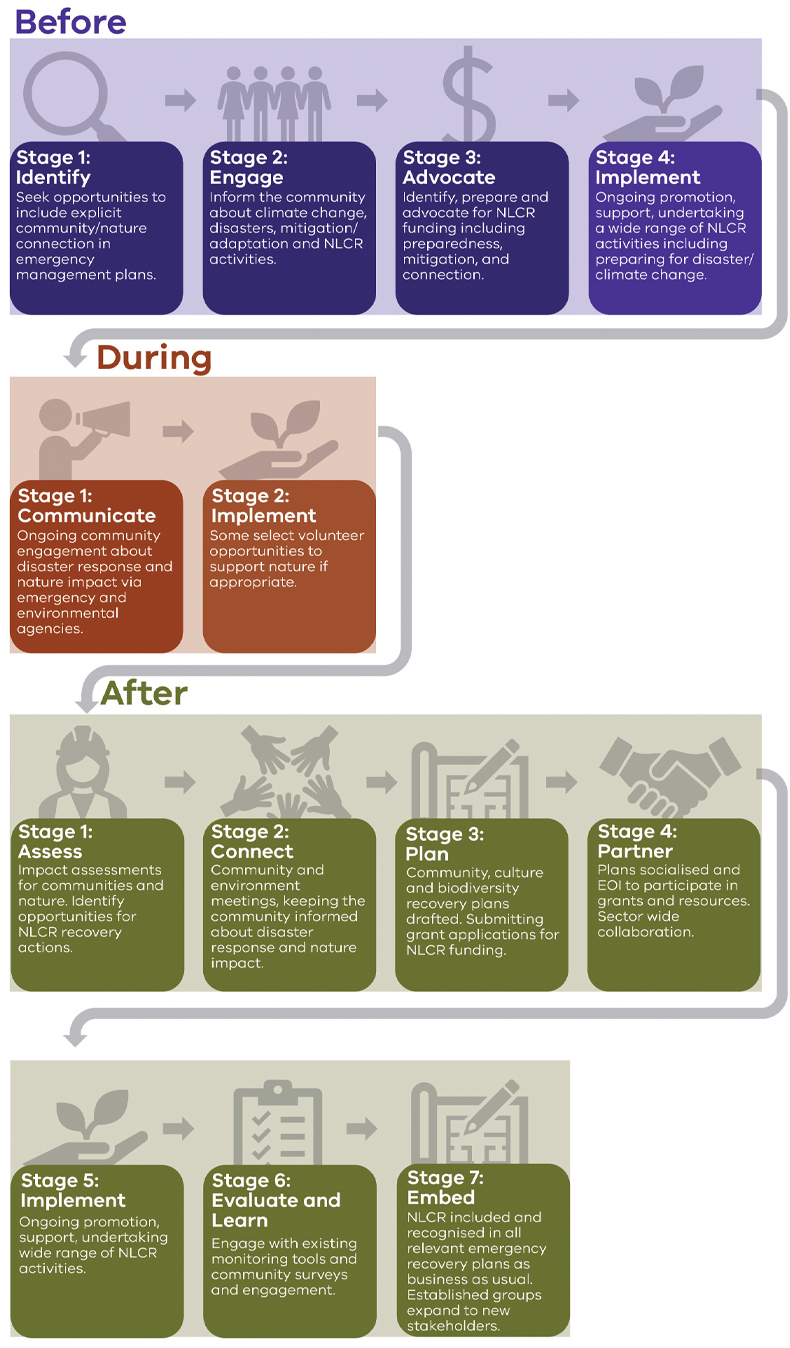
Although it has its roots in recovery, NLCR can be considered in all phases of disasters. The following roadmap sets out the general stages of action to incorporate NLCR before, during and after disasters (see Figure 2). Good disaster recovery and stronger resilience are directly influenced by the investment in planning and preparedness (Australian Government Department of Home Affairs 2018). Before disasters, NLCR activities support communities to build strong social capital and connections with each other and nature. This supports communities in connecting and knowing how to care for their local environments, and in understanding the mitigation, adaptation, preparedness and recovery plans in their area.
NLCR response and relief efforts, during and immediately after disasters, primarily focus on community engagement about what work is being done to support nature in the response phase.
Communications should be considered and regular, sharing impacts, consequences and reassurance (where appropriate).
There are many NLCR opportunities in early-, medium- and long-term recovery. Most immediately, it is important to communicate with communities to alleviate the feeling of nature as a threat. This needs to happen before finding a way to bring communities back to nature through including NLCR in recovery planning and recovery groups, engaging with communities, offering grant opportunities for NLCR activities, or implementing NLCR activities with local communities.
Knowing when to initiate NLCR activities should be guided by the local context and knowledge of the community and their recovery journeys; it will not be the same for everyone. For some, this can be quite early in the recovery process, for others, it may not be for years.
Eventually, NLCR extends beyond recovery and becomes the ‘new before’, building resilience, expanding and delivering sought-after nature-community connection activities, volunteering opportunities, continued monitoring, evaluation and publishing learnings in different formats to help others learn from this experience.
The NLCR Toolkit and Story Library
The NLCR Toolkit and Story Library has been a journey, decades in the making. The idea of NLCR was more formally developed and piloted by the Victorian Government following the 2009 Black Saturday bushfires (Reeves et al. 2019; Hames 2012). The momentum for NLCR, and associated learnings, continued to build, including recovery actions following the 2019–20 bushfires, where it was also incorporated into grant programs, and then again as part of the Victorian Government’s Flood Recovery Program. Consequently, it has yielded insights from different types of disasters and geographic contexts.
The NLCR Toolkit provides a framework for identifying opportunities to incorporate NLCR projects in disaster preparedness, recovery and resilience, and provides illustrative examples for building human-nature connection across the disaster phases, to support human and nature resilience. It has been developed to support any person, group or organisation that is seeking to meaningfully support disaster impacted communities and recovery for people and nature. This may include community and environment/conservation groups, local, state and national governments, non-governmental organisations (NGOs) and not-for-profit organisations (NFPs), Traditional Owner groups, schools, research organisations and funders.
A range of tools have been developed to support the development, design and implementation of NLCR activities including:
- templates to support planning and implementing NLCR activities
- practical examples showing groups undertaking NLCR actions in the different phases of disasters
- NLCR research and evaluation overview
- NLCR and emergency management principles
- mapping NLCR to existing frameworks
- NLCR resource hub.
The toolkit is accompanied by the Story Library that shares brief stories of NLCR initiatives across different contexts, communities, activities and outcomes. These stories were developed in collaboration with the stakeholders involved in developing the toolkit. They provide inspiration and examples when advocating for funding and planning for NLCR projects.
Societies internationally are recognising the urgent need for radical transformation in our relationships with nature as our natural world changes before our very eyes. Nature-led community resilience provides a clear opportunity for communities to be actively involved in supporting their own resilience and the resilience of their local environments. This reciprocal relationship recognises people healing nature, nature healing people.