


In the aftermath of a disaster event, there is an increased need for public participation in recovery-related decision-making, exceeding the typical scope of public participation in non-disaster settings. Community-led approaches to recovery are generally considered advantageous to ‘top down’ approaches, not only based on principles of democratic local governance, but also for sustainability, suitability to local context and the implementation benefits that local buy-in and participation can provide. Community recovery committees are a frequently used mechanism in Australia to enact community-led approaches to recovery. This paper outlines the development of a new self-assessment tool for community recovery committees to support these groups identify areas of agreement and disagreement in relation to governance, formation and scope and stakeholder engagement, based on learnings from past groups. This paper outlines the development and testing of the tool and subsequent insights for future community recovery committees and for government and other agencies supporting them.
Introduction
Australia is experiencing increased risk and exposure to disaster events (CSIRO 2020). The frequency, intensity and complexity of disasters globally is anticipated to increase (AIDR 2025), with an expectation that growing numbers of individuals and communities will experience multiple, compounding and cascading disasters (Pörtner et al. 2022).
In the aftermath of a disaster event, there is an increased need for public participation in recovery-related decision-making, exceeding the typical scope of public participation in non-disaster settings (Cretney 2018). However, this need often intersects with heightened tensions resulting from the time and deliberation required to collaborate on community priorities clashing with the need for urgent action and certainty in post-disaster settings (Cretney 2016; 2018; Olshansky et al. 2012; Vallance 2011).
Disaster recovery is highly multifaceted, often lacking clear definitions or solutions. It also involves many stakeholders from across community, government, the not-for-profit and private sectors. Recovery efforts are often beset by conflicting values, incomplete information and constantly shifting dynamics. This level of social and technical complexity demands strong collaboration among stakeholders. Collaboration enables shared ownership of both the problems facing disaster-affected communities and their solutions, promotes resource sharing, supports trial-and-error learning and helps navigate and resolve conflicts (Head and Alford 2015).
Community-led approaches to disaster recovery are generally considered advantageous to ‘top down’ approaches, not only based on principles of democratic local governance, but also for sustainability, suitability to local context and the implementation benefits that local buy-in and participation can provide (Cretney 2016, 2018; Dibley et al. 2019; Easthope 2018; Olshansky et al. 2012; Sanderson et al. 2025).
In Australia, ‘using community-led approaches’ has been enshrined as one of the 6 national recovery principles and has been endorsed by all state and territory jurisdictions and the Australian Government (AIDR 2018; Owen 2018). Despite the importance of community-led recovery approaches being recognised in Australian policy and doctrine (AIDR 2018; Australia-New Zealand Emergency Management Committee 2022), there is little agreement regarding what this means or how these approaches should be enacted to best support disaster-affected communities (Inspector-General Emergency Management 2021; Owen 2018; Vallance 2011).
This is evidenced by the different ways community-led recovery approaches are reflected in recovery plans across jurisdictions (Australia-New Zealand Emergency Management Committee 2022) and enacted within jurisdictions (Inspector-General Emergency Management 2021). Additionally, there are recognised challenges to using community-led approaches, including the demands on community members leading recovery efforts at a time of significant disruption and pressure (Inspector-General Emergency Management 2021; Pope and Harms 2022; Taylor and Goodman 2015; Vallance 2011), governments’ abilities to genuinely engage in community-led approaches (Owen 2018; Sanderson et al. 2025; Taylor and Goodman 2015) and concerns of potential burden shifting of government responsibility to unpaid community members or under-resourced community groups (Cretney 2016; Inspector-General Emergency Management 2021; Taylor and Goodman 2015; Vallance 2011). Understanding the wide variation in what decisions are made and how they are made when agencies engage with communities after disasters is crucial (Cretney 2018). There is broad agreement that despite community-led approaches being beneficial and desired in disaster recovery, they are rarely executed (Cretney 2016, 2018; Love and Vallance 2013; Owen 2018; Sanderson et al. 2025).
There are a multitude of mechanisms community-led approaches to recovery can take (Cretney 2016, 2018). Community recovery committees (CRCs) are one mechanism through which community-led approaches can be enacted in post-disaster settings. CRCs have existed for decades in Australia, for example, the Area-Coordinating Committees following the Ash Wednesday bushfires in 1983 (Hill et al. 1987), the Wye River and Separation Creek 2015 Christmas bushfires recovery committee (2009 Victorian Bushfire Community Recovery Committees 2011; Leadbeater 2013). While most CRCs are based around geographic communities, there have been examples of CRCs formed based on communities of impact (e.g. Bushfire Bereaved Advisory Group following the 2009 Victorian bushfires) (2009 Victorian Bushfire Community Recovery Committees 2011; Abotomy and Savage Kooroonya 2014; Emergency Management Victoria 2014). Committees or groups comprised of community members may engage with formal recovery actors in different ways and be referred to by terms including community recovery groups, renewal groups and resilience groups. The term CRC is mostly used in Victoria, where these groups are recognised in the State Emergency Management Plan (Emergency Management Victoria 2024).
While there is no formally agreed definition of CRC in the Australian Community Recovery Handbook (AIDR 2018) or jurisdictional doctrine, the term is used here to refer to ‘groups comprised of community members who are involved in recovery processes after a disaster’. While the term ‘involvement’ has been left intentionally abstract, this definition does not refer to committees comprised of people representing government or other organisations, despite the term being used in some jurisdictions to refer to committees comprised of agency representatives.
CRCs work together towards a shared goal or goals, formally or informally. In the absence of any instruction manual, formal guidelines or central authority articulating a shared framing of what CRCs ought to be, CRCs are necessarily shaped, in part, by the individuals who comprise them. These individuals bring different experiences, values and inherent biases. There is limited research focusing on these groups, but there is ample anecdotal evidence and grey literature to indicate that the way these groups form and operate in different locations is likely to vary widely, including their perceived role, goals, capacities and needs (2009 Victorian Bushfire Community Recovery Committees 2011; Bloor et al. 2023; Clifton Creek Community Recovery Team 2023; Emergency Recovery Victoria 2023; Lloyd and Hopkins 2022; SIERRACON 2024; Taylor and Goodman 2015). Examples of the documented types of work that CRCs have undertaken in Australian communities include developing communication channels and information resources to provide recovery-specific information to community members; coordinating external services; engaging in significant advocacy activities with emergency management organisations and government bodies for procedural change; facilitating events, workshops, support groups and memorials; coordinating public works; applying for and managing grants and donations; allocating funds for community run services and events; coordinating services such as tool libraries and plant nurseries; undertaking community preparedness programs and undertaking surveys and consultations to identify community priorities for local infrastructure (Abotomy and Savage Kooroonya 2014; East Gippsland Shire Council, n.d.; Emergency Management Victoria 2014; Mallacoota and District Recovery Association n.d.; Bloor et al. 2023; Sierracon 2024; Strathewen Community Renewal Association 2010).
For people engaging with CRCs, such as local or state government representatives, it can be challenging to respond constructively to the idiosyncratic needs of different community groups while maintaining the bureaucratic efficiency of scalable, preplanned solutions, especially when supporting multiple communities across a region or state (Bloor et al. 2023; Taylor and Goodman 2015). This is further complicated by the short-term nature of the locally based disaster recovery workforce, which is characterised by short-term roles, often with constrained resources, limited training, competing demands and high rates of attrition (Leppold et al. 2025; Sanderson et al. 2025).
Both the community members forming CRCs and the people supporting them face significant informational challenges in post-disaster settings. While some resources for CRC members exist in Australia, including Disaster Recovery Mentors Australia (a volunteer led mentor program), DisasterWise (a learning network for community leaders), case studies, reports and documented advice to help inform these groups (2009 Victorian Bushfire Community Recovery Committees 2011; Mitchell 2019; Quinn, Gibbs et al. 2021; Sierracon 2024), it can be an overwhelming challenge for people to access and absorb this information at the early stages of recovery. This can make it difficult for CRCs to identify the scope of their groups and their support needs, increasing the challenges for government and other recovery organisations to tailor the support they provide to communities (Bloor et al. 2023).
Overall, effective collaboration requires significant time and resources to develop and sustain. However, in a disaster-recovery context, such time is often scarce and residents need urgent assistance and timely decisions but government-funded supports are tied to budget cycles. The need for broad system reform notwithstanding, it is imperative that CRCs are offered timely support to identify the complexities of their group formation, governance, scope and the support they need.
This paper outlines the development of a self-assessment tool for CRCs that has been piloted as part of a multi-phase research project.
Method
Study design
Phase 1 of the study (Gibbs, Gallagher et al. 2021) identified evidence from literature relating to how governments can support community-led deliberative decision-making processes in post-disaster recovery settings and how governments can best leverage existing and emerging community organisations, structures and networks after disasters. In addition to summarising the existing research, a range of common challenges for CRCs and agencies supporting them were identified (Gibbs, Gallagher et al. 2021). From this, a preliminary self-assessment tool was developed to identify predictable challenges and to determine how CRCs wanted to approach issues likely to arise over the lifetime of their group. This preliminary tool identified areas of importance and predictable conflict within CRCs, drawing on stakeholder interviews, meetings with Bushfire Recovery Victoria team members, case studies, grey literature, academic research and tacit knowledge from a member of the research team with considerable experience working with a range of CRCs (Brady et al. 2023).
Phase 2 of the study (referred to as ReGroup) identified what CRC members considered the role of a CRC to be in terms of the group’s mission, objectives, make-up, social position and relationships. This phase tested 2 new tools (a self-assessment tool and a social network mapping tool) for their relevance to CRCs (Brady et al. 2023). A project reference group was formed comprised of 18 members who had experience of either being a CRC member or a recovery worker implementing community-led activities during recovery (including supporting CRCs). This reference group contributed to the research team’s refinement of the self-assessment tool by providing feedback through regular online meetings. The initial tool comprised 29 elements arranged under 3 headings of:
- formation and scope
- governance and decision-making
- stakeholder engagement.
These elements were presented on Likert scales in a self-assessment tool survey that individual members of CRCs could position themselves on.
Using the results from Phase 1 of the study, coupled with the tacit knowledge from the project reference group, Phase 2 was approached with a guiding assumption that there was no single ‘right’ way for CRCs to form, be governed, to choose the scope or goals of the group or be supported.
The intention of developing and testing a tool was to use experiences of people from past CRCs to help current CRCs consider issues that might be sticking points and to use this information to make better-informed choices. Despite differences between groups, the tools were designed to identify similarities in the types of issues that would be relevant, even if the desired approaches and outcomes of the groups were different.
This paper reports on the development and pilot of the self-assessment tool for relevance, usability and usefulness. Reporting on the other components of the ReGroup study, including a social network mapping tool can be found in be found in Brady et al. (2023).
Ethics statement
Ethics approval for this study was obtained from the University of Melbourne Human Research Ethics Committee, project identification #24698.
Recruitment
Six CRCs were identified by project reference group members as potential Phase 2 ReGroup study participants. Groups were recruited for diversity related to stages of establishment (e.g. well-established or new), hazard exposure (e.g. fire, flood) and geographic locations within Australia. The CRCs were contacted by email or telephone and provided with information about the project for consideration. CRC members were asked to participate in a one-day in-person workshop during late 2022 to early 2023. Five of the invited groups agreed to participate. One group withdrew before the workshop was undertaken. A sixth group expressed interest but the timing of the workshops was not suited to them.
Consideration for the workload of CRCs was a point of discussion within the project reference group. Thus, potential participant groups were instructed that a criterion to take part in the research was a genuine belief from the group members that they considered their participation would be beneficial.
Workshops
The workshops comprised 3 different activities relating to the study aims of Phase 2. These were piloting the self-assessment tool, piloting a social network mapping tool and using an exercise to explore the role of CRCs. This paper reports only on the trial of the self-assessment tool pilot.
The Self-Assessment Tool (see Figure 1 sample) was loaded onto a survey form using Qualtrics software. Participants were given iPads to use to individually complete the self-assessment tool in the workshop. This activity took most participants approximately 15 minutes to complete.
In the workshops, the individual responses were processed using statistical software program R1 to generate the results within 10 minutes of all participants completing the activity. As a simple and practical measure, the standard deviation for the spread of responses to gauge levels of agreement among group members was used. Participants were presented the results on a large screen so they could be viewed as a group, focusing on the elements of highest agreement and disagreement in the individual responses from group members.
After the results were presented, a group discussion was facilitated about the responses. Group members were asked to reflect on the things they found surprising or unexpected and to explore points of disagreement in more detail.
Following the workshop with the first group, minor adjustments were made to the phrasing of some statements in the self-assessment tool to reflect participant feedback. The tool was not altered after this.
Results
The Self-Assessment Tool was piloted with 4 CRCs from different locations in Australia that had experienced different disaster events. Table 1 lists the participant groups, their origin state and the total number of participants.
All of the groups identified that they had discussed at least some of the issues in the Self-Assessment Tool at some point but had not previously approached discussions in a structured or guided way. The group discussions were rich, thoughtful and nuanced. Participants asked each other to clarify their position and challenged some statements made by others in their group. In one site, the workshop discussions led members to agree on foundational changes in the proposed legal structure and governance arrangements of their group. While some of the groups had already addressed some of the points covered in the tool, they noted that discussions were still helpful as ways to think about future changes and what they could do differently.
Table 1: Participant groups and numbers of participants.
| Group | State | Setting | Number of workshop participants |
| A | NSW | Regional community. Community had experienced multiple flooding events in recent years, most recently in 2022. The group was formally established (with identified volunteer committee roles) approximately 6 months prior to participating in the workshop but had been running in a different form for nearly 8 years at that time. | 7 |
| B | Qld | Urban community. Community had experienced recent flooding event in 2022. Suburb had historic flooding. This group had been meeting for less than 6 months before the workshop and were in the stages of deciding how their group should be structured. | 6 |
| C | WA | Regional interface community. Community had experienced significant fire event in 2021 and historic fires. This group had formed approximately one year prior to their participation in the workshop. | 12 |
| D | Vic | Remote community. Community had experienced significant bushfire event in 2019-2020. This group had been formally established (with identified volunteer committee roles) for nearly 3 years at the time of workshop participation. | 8 |
Heterogeneity of groups
The discussions in each group had a different focus as a result of workshop participants and individual responses. This emphasised the heterogeneity of the groups and their contexts. Individuals brought different experiences, values and biases to the discussions and the groups had experienced a range of interactions with government and other agencies, which explains the substantial heterogeneity observed across groups. Of note, there was variation between and within groups. In workshop discussions, participants drew heavily on community history, context and dynamic changes since the disaster event. Tables 2 and 3 outline the highest areas of agreement and disagreement for each of the groups in the surveys.
In addition to a wide range of perspectives of formation, governance, scope and stakeholder engagement between groups, there was no single agreed view between the groups regarding the role of CRCs as representatives of communities. Two of the CRCs regarded their main function as being a voice on behalf of their community:
We’ve been put in a position of trust by people who don’t have capacity... they’ve said ‘I don’t have capacity, can you be my voice? I trust you, can you say this’.
(Member, Group B)
[CRCs] must be representative but avoid ‘doing’ representation... It must represent diversity, but once you’re doing the job [as a committee member] you have to leave your passion project at the door... you have to implement what your community has asked for. If you have people ‘doing’ representation, you get divisions and factions.
(Member from Group D at a later presentation about the work of their CRC)
While the other groups didn’t see themselves as fulfilling this role:
We are anarchists who want to get things done and are open to listening.
(Speaker A, Group A)
Yeah, but I don’t want people to say ‘where were you?’ I don’t want people to sue us, hold us accountable to things they thought would happen.
(Speaker B, Group A)
I think the word that is missing here is power or authority. I would like others to have power, not us to have all of the power.
(Speaker C, Group A)
This is a representation of community strength – what are the strengths of having different groups or people on a group. Everyone has different things they can do or take care of.
(Member, Group C)
Usefulness of tool
Participants in the 4 case study sites overwhelmingly reported that they considered the self-assessment tool to be both relevant and useful for their groups. They identified that it was helpful to be able to access a flexible tool that covered a range of relevant domains. Additionally, participants reported that having a structured format to follow was useful to guide group discussions and decision-making, saying:
I like that you’re not telling us the ‘right way’. There’s food for thought and options... I’d always prefer to be given the question than the answer, so this fits.
(Member, Group A)
Some participants noted that it was surprising to see areas of disagreement highlighted within the group that they hadn’t been aware of before the workshop, noting they felt the discussions this prompted were constructive and useful. Participants identified that it was easier to talk about areas of disagreement using this approach before they became problems.
In 2 of the workshops, the discussion prompted clarification and resolution regarding issues the group had been grappling with for some time.
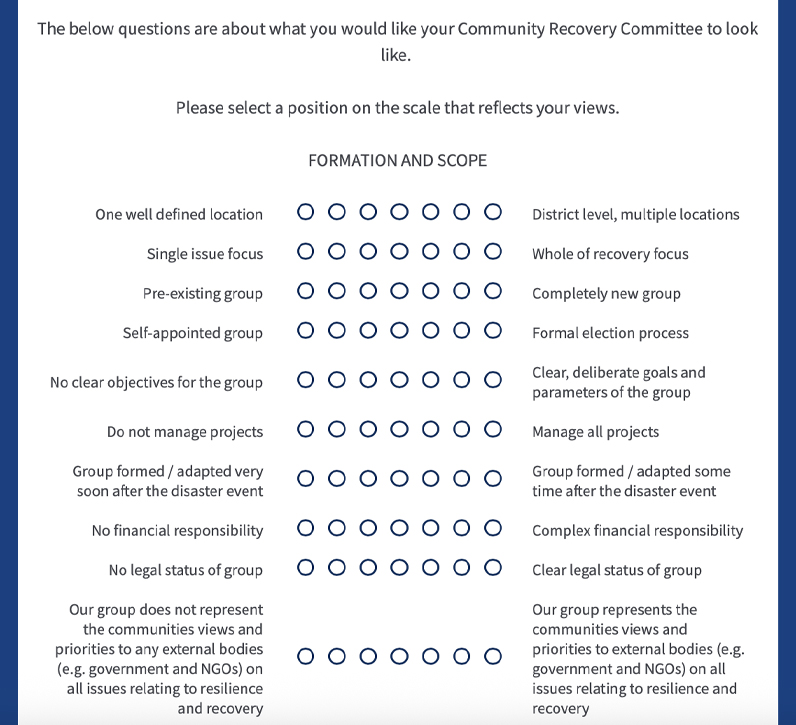
Figure 1: Extract from the self-assessment tool survey form.
A full copy of the tool survey is available at the NHRA website (Brady et al. 2023).
Role of government as an influence
Both government action and inaction in disaster-affected communities affected how groups formed and how they defined their scope, goals, governance and approaches to stakeholder engagement. There was a wide variance in the relationships that the 4 case site CRCs had with local and state government. One group felt the absence of government in their community had been a motivator for their group to form:
We’re not anti-government per se, they’re just not here.
(Member, Group A)
Another group saw their work as being closely aligned and integrated with government and considered that Another group saw their work as being closely aligned and integrated with government and considered that the division of work between community members, government employees and elected officials should be based on how results could most efficiently be achieved:
[You have to ask] What strengths are represented here? Who can get stuff done?
(Member, Group C)
One group had reservations about having a close relationship with government based on an agreed perspective between group members that neither local nor state government understood what communities needed. Group members made several comments about the inability of governments to be flexible or community-oriented and had concerns about government action after disasters being politicised. Based on these concerns, they saw the importance of their group informing government:
We should be a conduit that helps government prioritise intelligence and ongoing resource allocation.
(Member, Group B)
One group saw their role as being independent from government and had mixed experiences with government interaction. While they had some scepticism, they still noted overall benefits to working with government:
It needs to be based on trust... we haven’t always welcomed local government people [but] Shire staff as a liaison point is a helpful pathway back to council. It stops us barking up the wrong tree.
(Member, Group D)
Irrespective of how active, passive, collegiate or hostile participants felt government bodies were, all groups discussed the role of and purpose of their CRC in relation to government. This included being motivated to push against government agendas, filling a perceived gap left by government, addressing concerns they had about government process, providing advice or direction to government or improving information flow between government and community.
Table 2. Highest areas of agreement per group.
| Self-assessment tool element | |||
| Group | Formation and scope | Governance and decision-making | Stakeholder engagement |
| A | Project management. | Group will exist beyond government involvement. | Active engagement with the community beyond the committee. |
| B | Group represents community externally. | Group will exist beyond government involvement. | Active engagement with the community beyond the committee. |
| C | Group needs clear, deliberate goals. | Defined decision-making role of the group. | Connection to elected officials. |
| D | Group legal status. | Formal roles needed within group. | Planned, active engagement with community by the committee. |
Timing of the tool
Table 3. Highest areas of disagreement per group.
| Self-assessment tool element | |||
| Group | Formation and scope | Governance and decision-making | Stakeholder engagement |
| A | Group legal status. | Planning for representation for all sectors of the community. | Community members outside the committee are involved in the committee decision-making. |
| B | Group will take on financial responsibility. | Members should receive payment for committee involvement. | Media engagement. |
| C | Geographic location the group covers. | Planning for representation for all sectors of the community. | Media engagement. |
| D | When the group should form. | Term length of roles. | Level of engagement with elected officials. |
Timing of the tool
When workshop participants were asked if there was a ‘best’ or a ‘right’ time to access the self-assessment tool, there was very little agreement within or between groups, highlighting the need for flexibility. While some participants suggested that before a disaster would be the best time, others in their groups refuted this, saying they wouldn’t have engaged with it or even understood the magnitude and complexity of the post-disaster setting before they had experienced it:
Every community in the country should do this stuff before an event, like an evacuation plan. But we probably wouldn’t have done it.
(Member, Group D)
When some participants nominated ‘soon after the disaster event’ as being the best time, others in their groups rejected this, saying that the overwhelming nature of the immediate effects of the disaster would have prevented their ability to read, absorb or use the tool, even if they agreed that it would have helped. Pragmatically, one participant suggested that the best time would be:
... after one event, but before the next one.
(Member, Group A)
This reinforces the need for the recovery workforce to be trained in tools and resources available so that groups can be pointed to the right supports at the right time for them, noting that these tools may need to be introduced multiple times considering the post-disaster context of disruption and demand.
Discussion
This paper reports on the results of the pilot of the Self-Assessment Tool for CRCs in 4 disaster-affected communities in Australia. This study highlighted the heterogeneity between CRC perspectives on formation, scope, governance and stakeholder engagement of these groups. This variation reinforces the importance of understanding context when helping communities and the value of flexibility in tools and support available in such dynamic settings (Bloor et al. 2023; Love and Vallance 2013; Mitchell 2019). Mechanisms that support CRCs to navigate the difficulties of post-disaster settings and help negotiate the tensions between speed and deliberation are essential to community-led approaches to recovery (Olshansky et al. 2012). This tool may offer one such mechanism to CRCs and the agencies working with them.
This study also highlighted the inherent individualised nature of CRCs. Given the absence of a central authority articulating a shared framing of what CRCs ought to be and do, the membership of CRCs is shaped by individuals who bring distinct values and inherent biases and by their experience interacting with government and other agencies. Heterogeneity is not a limitation but an expected and defining feature of CRCs. This tool provides an opportunity to discuss differences and agreement in a structured way, offering utility to CRC members and government officials to potentially function more effectively.
The results of the pilot and workshop discussions drew out points of differences and disagreement between CRC members, reflecting the existing knowledge that priorities preferred approaches in post-disaster settings (Cretney 2018; Vallance 2011). The heterogeneity of CRCs highlighted in these results points to the challenges facing government and other recovery agencies to provide appropriate, tailored support to different groups (Bloor et al. 2023; Owen 2018) and reinforces the need for tools that can help CRCs and governments identify the formation, scope, governance and needs of CRCs. It also emphasises why rigid predetermined approaches to interactions with communities, such as requiring specific committee structures, are unlikely to work well in post-disaster settings (Dibley et al. 2019; Owen 2018).
There was no single agreed view between groups regarding the role of the CRCs as representatives of their communities, with some groups seeing themselves as representatives and others not. This is crucial for governments and emergency management agencies to understand as there is often an assumption that CRCs are and see themselves as community representatives in recovery planning. This tool may assist governments and emergency management agencies to understand the perspectives of the groups with which they are working.
The self-assessment tool was a helpful device for CRCs as a flexible, methodical and relevant way for groups to identify areas of disagreement and potential conflict and to give thought to issues that the groups may not have previously considered. The wide variation on when participants considered the right or best time to use the tool highlights the importance of flexibility for support available to communities after disasters. Additionally, it reinforces the importance of ensuring the disaster recovery workforce has experience and training in community engagement and clear and flexible approaches to how governments plan to work with communities after disasters.
These findings highlight the importance of how groups see themselves in relation to government. It is notable that, irrespective of how group members considered government (e.g. helpful, unhelpful, active, passive), all groups considered their formation, role, scope and approach to stakeholder engagement in relation to their perception of government. This is important for government agencies to understand. Government actions, inactions and approaches directly influence the shape and role of CRCs. This points to the importance of government agencies having a clear articulation of how they interpret the principle ‘using community-led approaches to recovery’ (AIDR 2018; Inspector-General Emergency Management 2021) as it will influence how their teams subsequently interact with disaster-affected communities.
These results suggest the great difficulty for those seeking a ‘silver bullet’ for predetermined models for CRCs, as the contexts of communities both before and after disasters varies so widely. There are valid reasons that organisations would prefer ‘off the shelf’ models for CRCs, including the need to provide scalable, equitable support across multiple locations simultaneously, often in a constrained environment (Bloor et al. 2023; Taylor and Goodman 2015) and navigating the realities of a short-term, transitory recovery workforce. However, these findings add to the body of research and grey literature confirming that this approach is overly simplistic and reduces the vital need for consideration of flexibility and community context (Cretney 2018; Love and Vallance 2013; Taylor and Goodman 2015; Vallance, 2011). Rather than continuing to ask ‘what is the best model for a CRC to engage with government processes?’ we suggest government and agencies instead ask ‘what do we need to better understand about the context of this disaster-affected community for a CRC to have the best chance of success?’. This change in assumptions requires governments and other support agencies to use flexible approaches, often simultaneously across different locations, in how they work with CRCs. The Self-Assessment Tool piloted in this study may support CRCs to improve clarity about their expectations, intentions and needs and for supporting agencies to clarify the support needs and approaches required.
Strengths and limitations of the study
The Self-Assessment Tool was designed with the intention of it being further developed as a digital resource, freely available to disaster-affected communities through the Australian Institute for Disaster Resilience website. Users would be able to access the tool at a time that best suits their needs, supported by guidance on its use. The digital versions would also generate real-time results, enabling CRCs to better identify community needs, inform planning and target support where it is most needed.
These promising findings support wide dissemination of the tool and further testing in diverse disaster and community contexts. However, to date, funding has not been secured to develop a scalable digital version. In its current form, the tools consist of static documents containing questions for consideration by CRCs but lacks the functionality to capture and display collective group responses or sentiment (Brady et al. 2023). This substantially limits its scalability and broader application.
Conclusion
This study piloted the use of a previously developed self-assessment tool with 4 CRCs in disaster-affected communities in Australia. Participants were positive about the relevance and benefits of the tool. The pilot study demonstrated proof of concept that the tool can support community-led approaches to recovery by assisting CRCs identify suitable governance structures, formation and scope and stakeholder engagement plans.
The wide range in views from the workshops about the preferred scope, formation, governance and stakeholder engagement approaches of CRCs demonstrates there is no ‘silver bullet’ model of how these groups are formed or governed, what their scope should be or how they should operate for individuals and agencies. This highlights the complexity of enacting community-led approaches as a central tenet of the National Principles for Disaster Recovery (NEMA 2026). These findings reinforce the importance of understanding the context of different communities and point to a strong need for flexible approaches as to how CRCs are supported. This tool has the potential to help CRCs learn from past operations and make decisions about formation, scope, governance and engagement approaches that are suited to their context.
This study shows the importance of government and other agencies developing a clear understanding of how community-led approaches to recovery are interpreted and operationalised across different organisations and jurisdictions. The findings support further rollout and trialling of the tool and underscore the need for government bodies and other agencies to remain cognisant of how their actions—or inactions—can influence and shape the role, function and scope of CRCs.