


Garden management plays a crucial role in reducing bushfire risk at the wildland-urban interface, yet implementation of fire-safe practices remains challenging. An analysis of garden assessments and in-depth interviews with 23 property owners in Greater Hobart, Tasmania, examined how technical, social and emotional factors influence garden bushfire adaptation decisions. Using the Cynefin framework and complexity theory, this study demonstrates that successful adaptation addresses multiple domains of complexity, from straightforward vegetation management to complex socio-emotional attachments to garden spaces. Findings reveal that while personalised garden assessment reports can motivate change, their success depends on a broader set of conditions. Barriers include practical constraints (e.g. green waste management), emotional attachments to garden elements and difficulties obtaining context-specific guidance. By applying the As Low As Reasonably Practicable (ALARP) principle, this study identified cost-effective interventions across the 4 avenues of institutional support and resource management, individual garden bushfire adaptation, personalised technical guidance and community support networks. This research suggests that creating fire-adapted gardens requires coordinated support systems that address both practical implementation challenges and emotional connections to garden spaces.
Introduction
The growing complexity of bushfires reveals how poorly human societies have adapted to natural environments (Cunningham et al. 2025; Bowman 2024). As symptoms of climate change and ecological breakdown, fires present wicked problems that complexity theory can help to better understand and respond to.
Tasmania (Lutruwita1) presents an ideal opportunity to examine garden bushfire adaptation as 98% of its land area is classified as having bushfire-prone vegetation (Tasmanian Fire Service n.d.). In Hobart (Nipaluna), most households in the wildland-urban interface (the area where settlements are in close proximity to natural environments such as forest and shrubland) are highly susceptible to property loss (City of Hobart 2022). The region has experienced devastating bushfires throughout its history. In 1967, fires claimed 64 lives and destroyed approximately 1,400 buildings. This is a stark reminder of the area’s vulnerability (Haynes et al. 2008; Power and Wettenhall 1970; Richards et al. 2014). As climate projections indicate more frequent high-fire-danger conditions (Fox-Hughes et al. 2014), it is critical to implement effective risk-reduction strategies.
Residential gardens are a critical yet underutilised zone for fire risk reduction. Recent research demonstrates that properly managed gardens can serve as effective asset protection zones, significantly reducing house loss during bushfire events (Gibbons et al. 2018; Ondei et al. 2024). However, despite available guidance on garden bushfire risk reduction, a persistent gap remains between awareness and implementation of mitigation measures.
This study aimed to identify pragmatic, complexity-informed pathways for bushfire adaptation of gardens at the wildland-urban interface. Using the Cynefin framework and ALARP principle, the study examined technical, social and emotional dimensions of garden fire risk reduction and proposes interventions across the 4 levels of institutional support and resource management, individual garden bushfire adaptation, personalised technical guidance and community support networks. The findings will assist decision-makers, fire agencies and practitioners working to support communities to 'live with fire'.
Methods
This study builds on 2 companion studies examining garden fire hazards in Greater Hobart, Tasmania (Ondei et al. 2025 and Gjedrem et al. 2025). These studies investigated options to reduce property vulnerability through garden design which, combined with structural improvements to buildings (e.g. ember-proofing), is a critical component of comprehensive bushfire preparedness (March and Rijal 2015). This research focused on garden management as an accessible, adaptation approach that householders can implement. Fire hazard assessments were based on fuel characteristics (amount, flammability, spatial arrangement) in 21 gardens in the Greater Hobart area. This was combined to obtain a garden risk score (Ondei et al. 2025). Gardens were divided into 4 biophysical categories based on the combination of garden bushfire risk (‘Low’ or ‘High’) and landscape bushfire risk (‘Low’ or ‘High’) as a benchmark for social science inquiry (Gjedrem et al. 2025). Customised risk-reduction recommendations were provided to residents in these areas during a mixed-methods survey that included mapping, photo-elicitation garden walks and cognitive debriefing. Semi-structured interviews were conducted using a non-violent communication approach (Rosenberg 2015) to create a friendly and empowering interview atmosphere. By combining quantitative and qualitative analyses, we aimed to understand the technical and social dimensions of implementation of garden fire adaptation. More information on the biophysical assessment and the social survey can be found in Gjedrem et al. (2025) and Ondei et al. (2025).
This study identified practical implementation pathways for a range of stakeholders such as local government and fire agencies. This paper presents a framework-informed analysis of insights from Gjedrem et al. (2025). The Cynefin framework and complexity theory (Kurtz and Snowden 2003) and the As Low As Reasonably Practicable (ALARP) principle (Jones-Lee and Aven 2011) were applied as sense-making tools, highlighting 4 avenues of intervention of institutional support and resource management, individual garden bushfire adaptation, personalised technical guidance and community support networks. These avenues provide a thematic overview of different implementation strategies.
Ethics statement
This study received ethics approval from the University of Tasmania Human Research Ethics Committee (Ref. #29988).
Garden bushfire mitigation – a complex system perspective
Bushfires have shaped ecosystems for millions of years, but anthropogenic climate change, loss of traditional landscape management practices, human migration and urban expansion have transformed bushfire from a natural ecosystem process into an increasingly catastrophic hazard, particularly where human settlements meet fiery vegetation at the wildland-urban interface (Bénichou et al. 2021; Johnston et al. 2024). In Australia, the devastating effects of previous fire seasons have highlighted the urgent need for more effective approaches to bushfire risk reduction (Nolan et al. 2021; Haynes et al. 2008; Sturzenegger and Hayes 2011; Campbell et al. 2024). This need is critical given that the majority of Australian disaster funding is allocated to recovery (87%) (Colvin 2024) with the remaining funding allocated to preparedness, prevention, response, resilience and risk reduction.
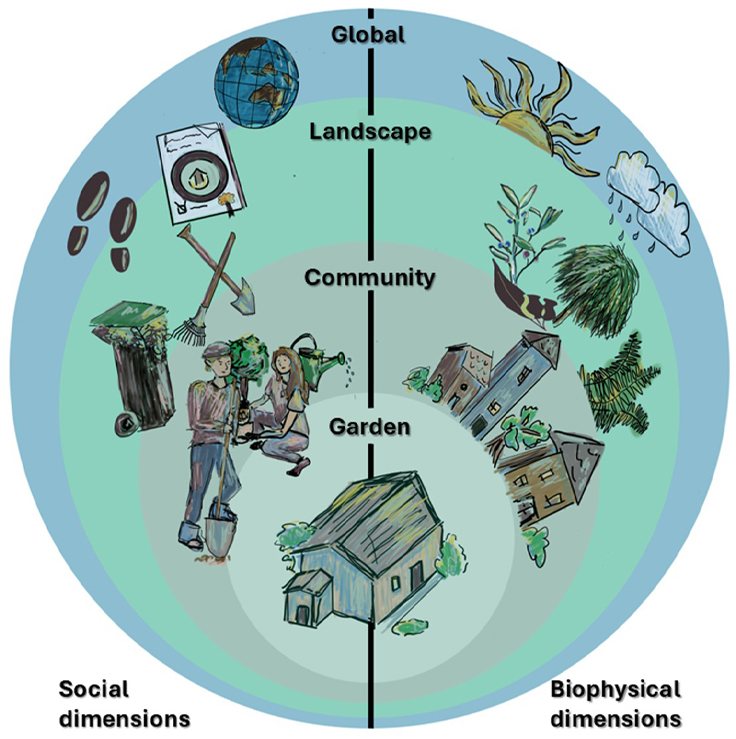
Figure 1: A residential bushfire adaptation position framework shows the social and biophysical domains that span a range of geographic scales. Image: Gjedrem and authors.
Figure 1 shows that garden adaptation is part of a broader context of bushfire management (Wise et al. 2014) and involves social, economic and environmental factors that shape the implementation of fire-wise gardens. These adaptation pathways are not linear progressions from bushfire hazard awareness to bushfire hazard mitigation action, but are dynamic journeys shaped by multiple feedback systems between individual decisions, community networks and institutional support systems. Gardens and landscapes are not always carefully designed. They are the product of the interplay between human agency (such as priorities, limitations, opportunities and worldviews), climate and the natural environment.
The residential bushfire adaptation position framework shows the biophysical and social realities that shape fire adaptation pathways (Log et al. 2020) (Figure 1). Social dimensions are shown on the left side and biophysical dimensions are shown on the right side of Figure 1. The social dimension illustrates that a garden’s bushfire risk is shaped by the local community’s capacity and opportunities to undertake mitigation initiatives. These are shaped by the institutional landscape (e.g. support networks, infrastructure, resources available and regulations). In turn, local circumstances are shaped by global systems and events (e.g. trends, politics, economic systems, collaborations, crisis and path-dependencies). The biophysical dimensions illustrate the residential garden situated within the community, surrounded by neighbouring properties and/or intermingled in the natural landscape; the latter determining bushfire risk, which is dynamically affected by global climatic conditions and local weather.
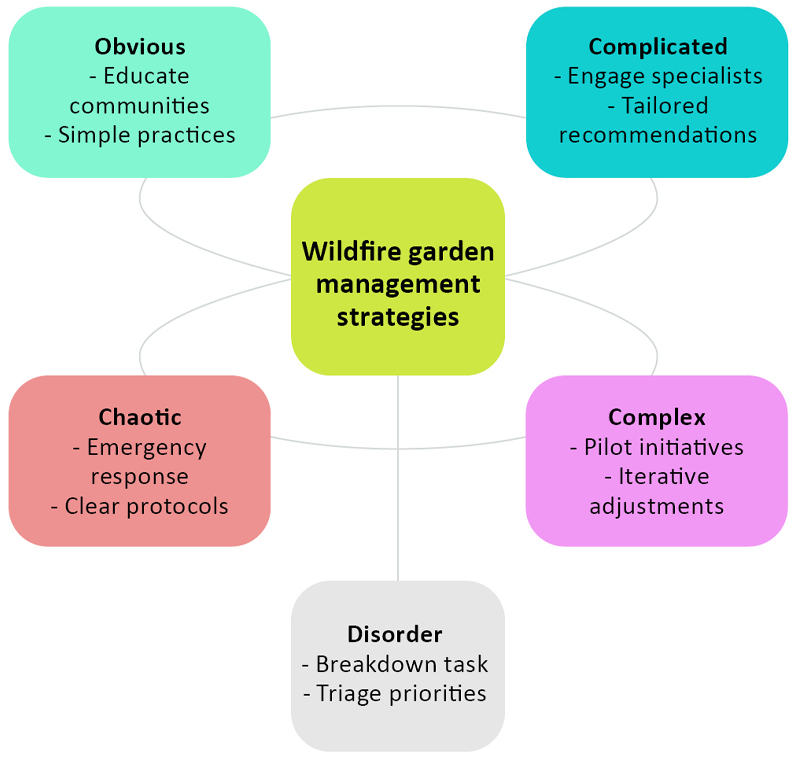
Figure 2: The Cynefin framework can be tailored to investigate pathways for bushfire garden management strategies. Source: Adapted with permission from Kurtz and Snowden (2003)
Note: Text in bold shows the different complexity dimensions. The bullet points are examples of bushfire garden management strategies.
The complexity of bushfire adaptation is especially evident in high-risk landscapes where garden management interacts with broader vegetation and landscape processes that influence a property’s vulnerability. The Cynefin (Welsh for ‘habitat’) framework is used to consider the multiple domains of complexity that garden fire adaptation encompasses (see Figure 2) to inform decision-making in times of uncertainty.
The Cynefin framework was developed as a sense-making framework for problem-solving (Kurtz and Snowden 2003) and includes different philosophical domains that inform garden adaptation. Some aspects represent ‘simple’ solutions with clear cause-and-effect relationships, such as clearing dry vegetation (the 'obvious’ domain). Others require expert knowledge (the 'complicated' domain) such as measuring effects of garden characteristics to obtain a detailed understanding of the garden’s bushfire risk and to inform evidence-based risk reducing measures (Ondei et al. 2025). Some adaptations emerge from complex interactions between social, emotional and ecological factors that cannot be predicted (the 'complex’ domain). These include community initiatives for bushfire risk reduction that are shaped by the resources and experience available.
There is also a ‘chaotic’ domain where time-constraints challenge possible solutions, such as situations where a bushfire threatens the home and immediate action is needed such as defending the property or evacuating (Dilworth and Price 2024). Such chaotic situations are outside the scope of this study. A fifth element was introduced by Kurtz and Snowden (2003) to navigate priorities (the ‘disorder’ domain) that highlight the importance of breaking down tasks and triaging priorities when dealing with complex situations. The Cynefin framework helps explain why bushfire hazard awareness (Gjedrem et al. 2025; Lucas et al. 2022) among householders does not, in itself, dictate outcomes for bushfire garden adaptation.
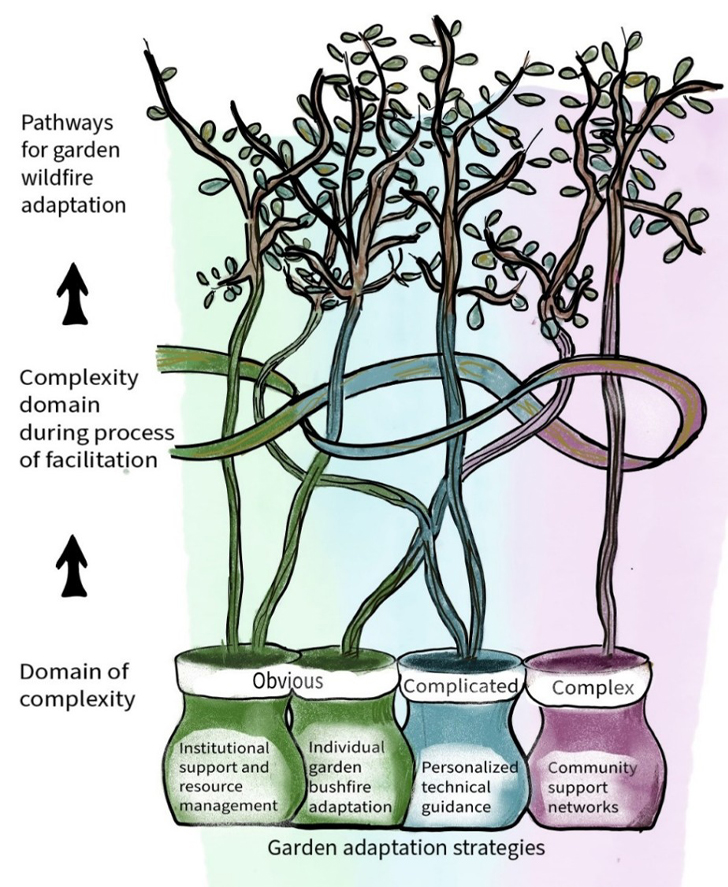
Figure 3: Pathways for garden bushfire adaptation shows how contrasting strategies are shaped by institutional, community and individual knowledge, support and resource availability. Image: Gjedrem and authors.
As the Cynefin framework is an adjustable model, it provides flexibility in its adaptation. Applying this framework to the empirical insights of Ondei et al. (2025) and Gjedrem et al. (2025) helped identify ways to improve garden bushfire adaptation across the complex, complicated and obvious domains. This included 4 interventions of:
- institutional support and resource management (e.g. coordinated services such as green waste collection and equipment provision, which may be delivered by local government)
- individual garden bushfire adaptation (e.g. resident-led property modifications and maintenance practices)
- personalised technical guidance (e.g. tailored expert assessments and property-specific recommendations)
- community support networks (e.g. neighbourhood groups, peer learning systems and collective action initiatives).
Figure 3 illustrates that intervention strategies (i.e. institutional support and resource management, individual garden bushfire adaptation, personalised technical guidance and community support networks) may move across different domains of complexity. The roots, symbolising the foundational strategies, are planted in their respective pots. Meanwhile, the trunks of the small trees represent the evolving pathways that move between the complexity domains as they are facilitated. The branches and leaves depict the various initiatives that emerge from these pathways that become entangled and branch out in different directions that shows the dynamic, interconnected nature of the adaptation process. These pathways span multiple domains of complexity, from straightforward vegetation management to complex social and emotional effect on garden adaptation.
Immediate opportunities through the ALARP lens
As apparent in the Cynefin analysis, forging efficient garden bushfire mitigation initiatives depends not only on individual awareness but on technical knowledge, community networks and institutional resources that make adaptation practically achievable while respecting complex garden values. Given these challenges, the ALARP principle offers a pragmatic way forward. The ALARP principle suggests that risks should be reduced to a level where further risk reduction would be grossly disproportionate to the benefits gained (Jones-Lee and Aven 2011; Log et al. 2020). Applying this principle to garden fire adaptation, this study identified several immediate, cost-effective interventions that could significantly reduce risk while requiring modest investment compared to expenses associated with bushfire suppression and rebuild.
Table 1 shows 4 intervention avenues (i.e. institutional support and resource management, individual garden bushfire adaptation, personalised technical guidance and community support networks) and ALARP intervention initiatives that were highlighted by participants in Gjedrem et al. (2025) during interviews on bushfire adaptation in Greater Hobart.
The ALARP interventions are not quick-fixes, but practical steps that can be taken while navigating multi-faceted problems. Integrating practical support mechanisms with existing emergency management programs could strengthen overall community resilience (Daniel 2024). It is important to note that individual ALARP interventions may not directly reduce overall bushfire risk to houses, rather, they address critical bottlenecks in the adaptation pathway. For example, increased green waste collection does not itself reduce fire hazard, but it removes a barrier that prevents homeowners from clearing flammable vegetation and maintaining bushfire-adapted gardens.
Table 1: Identified ALARP interventions.
| Intervention avenue | ALARP intervention initiatives | Quotes from participants | Cynefin domain of complexity |
| Institutional support and resource management |
|
|
Obvious initiatives and process for facilitation: Obvious initiatives and complicated process for facilitation: |
| Individual garden bushfire adaptation |
|
|
Obvious initiatives: Complex process for facilitation:
|
| Personalised technical guidance |
|
|
Complicated initiatives and process for facilitation: Complicated initiatives and obvious process for facilitation: |
| Community support networks |
|
|
Complex initiatives and process for facilitation: Initiatives can fail and succeed. Successful initiatives can be used as an example, but there is no guaranteed blueprint solution. |
Institutional support and resource management
Examples of ‘institutional support and resource management’ initiatives include interventions that reduce risk such as increasing the frequency and effectiveness of green waste services, for example increased green waste collection during fire season, additional green waste bins, special collection days for larger materials and community green waste drop-off points. Green waste management emerged as a critical need and participants consistently identified waste removal as a barrier to maintaining fire-safe gardens. Other interventions included tool-sharing programs, equipment lending libraries, funding for essential equipment purchases, grants for arborist services, subsidies for fire-resistant plants, assistance for elderly or disabled residents and incentives for collective neighbourhood initiatives.
In some cases, the solution may be obvious. In others, complex bureaucratic and legal processes can overwhelm ordinary infrastructure support that can affect residents' abilities to maintain fire-safe practices. This is evident in the case of legal and administrative restrictions on installation of fire bunkers in most Australian states and territories (Bowman and McCormack 2023). Prompting fire-wise gardening resource investment as well as the evaluation and adjustment of regulations and policy ensures they are effective and sensitive to community needs (Kurtz and Snowden 2003).
The limited capacity of some residents to maintain community cooperation points to a fundamental need for institutional support and structured programs that provide consistent, long-term assistance while building community capacity (Ascoli et al. 2023). To be effective, bushfire adaptation requires coordinated support across individual, community and institutional levels (Frandsen et al. 2011). Participants in this study highlighted the benefit of institutional support to remove cognitive, time-based and financial barriers to community collaboration.
Individual garden bushfire adaptation
Examples of ‘individual garden bushfire adaptation’ initiatives include adding flexibility into garden bushfire adaptation programs to avoid competing values derailing the initiatives. The delivery of personalised, flexible and non-judgemental garden assessment reports proved effective in motivating fire-safe garden practices. Rather than prescribing rigid changes, assessments acknowledged existing garden values while suggesting practical modifications. Other interventions included integrating multiple objectives in garden bushfire adoption plans (e.g. gardening for wildlife and improve and maintain aesthetic levels) and account for emotional dimensions of garden adaptation.
Open-ended questions, reflective listening and empathic engagement provide a foundation for community-centred communication with garden owners (Rosenberg 2015). Open-ended questions allow participants to share their experiences and perspectives on their own terms. This sets a tone of respect and collaboration. Using open-ended questions encourage participants to explore and articulate their thoughts and feelings in-depth. This approach helps to gain a deeper understanding of perspectives. Active listening allows researchers to check if there is mutual understanding and validates participant experiences and feelings. Empathetic engagement acknowledges the emotions and values expressed by participants. In discussing sensitive topics like bushfire risks, showing empathy is crucial to build trust and openness.
Garden bushfire adaptation offers landowners an opportunity to reduce bushfire risk. By implementing risk-reduction measures in their gardens, owners can contribute to increased safety measures. Every mitigation of risk helps because it removes potential pathways for destruction. Understanding bottlenecks that influence residents to adapt fire-wise gardening has challenged scientists and bushfire practitioners given the complexity of processes involved. For example, the most nuanced finding of this study concerned the role of emotional attachment in garden adaptation decisions while balancing competing obligations of everyday life (Koksal et al. 2019). Participants reported struggling to balance fire safety with deeply held values around environmental stewardship and aesthetic preferences – in addition to the element of cost. The emotional dimension of garden management has been largely overlooked in traditional fire safety approaches but proves crucial to understand implementation barriers as highlighted by other studies (Bradstock et al. 2014; Edwards and Gill 2016; Eriksen and Gill 2010; Eriksen and Prior 2011; Lohm and Davis 2015; Paton et al. 2008). Research shows that adaptation measures are likely to be implemented when they accommodate rather than override existing values (Eriksen and Ballard 2020; Lohm and Davis 2015). Therefore, an effective way to improve adaptation is to increase the self-esteem and motivation of residents by highlighting existing aspects in the garden space that function well regarding bushfire-wise gardening.
Facilitation of initiatives that enforce individual garden bushfire adaptation are complex, tangled up in multiple and sometimes contradictory values. Thus, these relationships may be readily described but not easily predicted. This stands in contrast to assumptions of traditional notions of behavioural theory, particularly the assumption of order, rational choice and intentional capability. Inspired by Kurtz and Snowden’s (2003) Cynefin framework, this study suggests forging a sense of collective direction and not subscribe to rigid objectives that create perverse incentives.
Personalised technical guidance
Personal technical guidance is information provided to garden owners based on scientific evidence on measures that reduce bushfire hazard in gardens. Examples of personalised technical guidance initiatives include property-specific assessment and recommendations. These assessments present recommendations in a structured format (bullet point overview) that participants valued for simplifying decision-making and supporting evidence-based garden bushfire mitigation. Clear visual guides for garden zoning and educational programs about a fuel-free zone, based on Ondei et al. (2024), help make mitigation tasks less overwhelming and provide clear priorities. This is particularly valuable for owners of larger properties where comprehensive modifications could seem daunting. The lack of awareness among garden owners regarding the importance of the fuel-free zone (0–1.5m from houses) (Gjedrem et al. 2025) is an important area for public education as the immediate house surroundings play a fundamental role in property protection during bushfires.
The research revealed complex interactions between knowledge barriers and implementation challenges. Participants frequently reported difficulties, accessing and applying context-specific information. Providing technical recommendations can increase individual and community agency and capacity where individuals can work as change-makers.
Regular garden assessment programs allow for regular feedback and monitoring tools that help residents track their progress and adjust their approaches as needed. Other interventions include locally specific plant guides with photos, seasonal maintenance checklists, expert consultation for complex decisions, staged implementation plans, clear and accessible guidelines and standards as well as local bushfire-adapted garden demonstrations.
It must be acknowledged that personal technical guidance initiatives are complicated and rely on specialised knowledge of parameters such as the landscape topography, fire weather warnings, landscape models, plant and object flammability, spacing and cover of plants and flammable objects (Gibbons et al. 2018; Ondei et al. 2024). The process to increase knowledge about garden bushfire adaptation is complicated by the inclusion of many stakeholders (CSIRO n.d.) that may deliver expert advice and regulations across sectors. Nevertheless, over time, technical and expert knowledge may become ‘common sense’ and intuitive practises through learning-and-doing processes. To bridge the gap between professional assessment and everyday practice requires complex expert guidance on garden fire adaptation being accessible to residents. To achieve this requires repeated cycles of assessment, action, learning and confidence building that move conscious effort to intuitive understandings of bushfire adaptation. In the future, people might learn more about bushfire-wise gardening through mobile applications. Smartphone apps for self-assessment and advice could enable reductions in the cost of personalised garden bushfire mitigation advice. This would allow for self-assessment.
Community support networks
Examples of ‘community support networks’ initiatives include shared labour pools for physical work, peer learning programs, community skills exchange networks, mentoring systems between experienced and new residents and neighbourhood working bees expose practical resource constraints, from physical labour requirements to equipment access. These networks can create mutual accountability and encourage sustained engagement with fire adaptation practices. This can be established through communal working bees (informal groups of residents who come together to do manual work for a shared benefit).
Community support networks are clusters of community members that aid and support each other either through physical work or knowledge exchange. Such networks may be informally or formally organised. This research revealed complex dynamics around community-level support mechanisms for garden adaptation. While participants frequently expressed desire for coordinated neighbourhood actions, particularly in high-risk landscape areas, the reality of establishing and maintaining such networks is challenging. This reveals a crucial gap between desired support and current capabilities.
Community support network initiatives are complex and are affected by a broad set of factors that include social, individual and biophysical. The community networks might depend on resourceful individuals (e.g. local champions) who can lead such initiatives. However, relying on volunteer-driven initiatives raises important sustainability concerns. As McLennan (2022) noted, delegating responsibility for bushfire mitigation to volunteers and overburdening them can strain community resources and potentially decrease long-term engagement. The informal nature of volunteer networks makes them exposed to burnout, changing personal circumstances and uneven participation across communities. Facilitating community collaboration is an iterative process and success in one area does not predict success of similar projects elsewhere. The methodologies of such initiatives need to be relevant and sensitive to their context. Research indicates that supporting ongoing initiatives may be efficient due to their pre-established roots in the community (Ascoli et al. 2023).
Conclusion, recommendations and future directions
This study analysed fire risk scores of 21 gardens in the Greater Hobart area of Tasmania. The findings demonstrated that garden fire adaptation is not only a technical challenge but also a complex socio-ecological process that benefits from coordinated efforts across garden, community and landscape scales that interact in complex ways. This was captured using the Cynefin framework. The ALARP framework identified practical pathways to implement actionable responses that are targeted, cost-effective and address the technical and social aspects of garden adaptation.
Using these frameworks, findings suggest that personalised garden assessments can effectively motivate fire-safe practices, although their success depends on delivery that acknowledges existing garden values and emotional attachments. While community networks show promise for knowledge sharing and resource pooling, the widespread implementation and long-term effectiveness of fire-wise design practices requires structured institutional regulation such as alignment with existing standards (e.g. AS3959-2018) and support. This research suggests that future initiatives will be most effective when they combine technical expertise with enhanced support systems that address practical implementation challenges and the pre-existing values of residents while promoting fire safety. Findings suggest that government agencies, as well as non-government organisations with a stake in bushfire adaptation (e.g. local councils, fire agencies and insurance companies) continue to develop their community engagement iteratively.
Translating these potential pathways and enabling conditions into effective intervention programs remains challenging. Future research could examine adaptation pathways across diverse geographic and socio-economic contexts through longitudinal studies, explore practical implementation challenges through action research or investigate multiple-objective approaches that balance bushfire safety with other values and aspirations (e.g. biodiversity and aesthetic).
As bushfire risks intensify at the wildland-urban interface, developing effective support systems for garden-level adaptation becomes increasingly important. By better understanding the dynamics and implementing targeted interventions, communities can create fire-resilient environments that maintain the multiple values that gardens provide.