


Equitable access to emergency information is essential for reducing risks and minimising disaster impacts for non-English speaking and culturally diverse communities. Migrant and refugee groups often rely on trusted sources within their personal and cultural networks to receive, interpret and share critical information during emergencies. This report documents a ‘Translating and Interpreting in Disasters’ workshop, delivered in regional Victoria in 2025 to exemplify how hazard and response agencies are leveraging existing networks to amplify emergency communications and support multilingual and culturally diverse communities.
We discuss the complex barriers faced by regional multicultural populations during disasters, and emphasise the central role of community connectors in amplifying official communications. This report aims to highlight the importance of ongoing agency community engagement and targeted training to strengthen resilience and improve disaster outcomes for regional communities. Recommendations are provided to inform future practice, support inclusive emergency management practices and foster sustainable community resilience.
Introduction
Multicultural and linguistically diverse communities often face greater risks during emergencies due to language barriers, limited awareness of local hazards and unfamiliarity with emergency management processes (O’Brien and Federici, 2020; Ogie et al. 2018; Xiang et al. 2021). Recurring disasters including floods, bushfires and the COVID-19 pandemic, have all illustrated the longitudinal challenges in ensuring equitable access to information for multicultural communities in regional Victoria (Ajak et al. 2024; Ethnic Communities’ Council of Victoria (ECCV) et al. 2023). Community feedback from these events raised critical concerns about the effectiveness of emergency communication approaches and resources (Wild et al. 2021).
Empirical studies have evidenced the preference of migrant and refugee communities to rely on personal, trusted sources, such as friends, neighbours, community leaders and bilingual community members, for emergency information (Ajak et al. 2024; Atkinson 2023; Ogie et al. 2018; Piller et al. 2020). Information is commonly disseminated through established personal and cultural networks via verbal communication, telephone contact, or digital messaging platforms (ECCV et al. 2023). These ‘community connectors’ (Ajak et al. 2024) operate as ‘bridges’ to connect with those who are otherwise hard to reach through traditional emergency communication channels (Wallace et al. 2019). Community connectors play a pivotal role, not just in the provision of translated information, but also through contextualising advice, building community confidence and, through this, enabling safer and better-informed decision-making (ECCV et al. 2023). Through these informal networks, community connectors can positively influence preparedness, response and recovery efforts in migrant and refugee communities (Ajak et al. 2024; Atkinson 2023; Piller et al. 2020).
Background: the role of community connectors during the 2022 Shepparton Floods
The Greater Shepparton region was significantly impacted by flooding in October 2022 (Victoria State Emergency Service (VICSES 2023). Approximately 900 houses were inundated by floodwater, and close to 10% of these properties were partially or completely destroyed or deemed uninhabitable, causing long-term displacement amongst the local population (VICSES 2023). The Greater Shepparton region is culturally and linguistically diverse (Greater Shepparton City Council n.d.) with more than 17% of the region’s population speaking a language other than English at home (Bureau of Statistics 2021). However, flood warnings before and during the event were only available in English, and this created considerable challenges for diverse community groups in accessing, understanding and using the information provided by official emergency channels (ECCV et al. 2023). Newly arrived individuals were found to experience unique hardships during the event and reported significant fear and anxiety caused by being trapped in, or surrounded by, rising floodwaters, and not knowing about evacuation arrangements or how to contact authorities for help (ECCV et al. 2023).
The 2022 floods in regional Victoria demonstrated the important role that community connectors play in bridging communication gaps. The ECCV report highlights that during the Shepparton floods, newly arrived individuals and multicultural groups depended heavily on multicultural community leaders and community connectors for interpreted emergency information and guidance (2023). By leveraging their established relationships within language and ethnic communities, community connectors advocated for safe evacuations and access to culturally appropriate support services, directly improving disaster outcomes for vulnerable populations (ECCV et al. 2023). A group of local individuals, having played a crucial role during the disaster, advocated for improved access to training and support in translation and interpreting (T&I) to help them perform these functions more effectively, and professionally. In response to this need, Monash University, funded by Emergency Recovery Victoria (ERV) and the Greater Shepparton City Council (GSCC), developed the Monash University T&I Training Package. One of the workshops within the broader training package focused specifically on translating and interpreting during emergency events.
This report examines the ‘Translating and Interpreting in Disasters’ workshop delivered in Shepparton, Victoria in June 2025 as part of the broader Monash University T&I Training Package. The workshop trained local community connectors on how to access, navigate and understand critical information contained in official emergency communications. We first provide background context to the development of the training workshop and detail the training workshop activities. We also share learnings from the workshop, including agency recommendations on ways to capitalise on community connections in diverse regional communities to support community response capability, and enhance local disaster resilience.
‘Translating and Interpreting in Disasters’: a community-based training workshop
The ‘Translating and Interpreting in Disasters’ workshop, was collaboratively facilitated by the Monash T&I program, the Australian Bureau of Meteorology (the Bureau) and Victoria State Emergency Service (VICSES). It brought together experts in meteorology, emergency management, translation practice and intercultural communication. The workshop was attended by a cross-section of community members, representing diverse cultural and linguistic groups. The workshop began with a presentation about flood risks in the local area, and an open forum discussion about participants' previous experiences of local hazards or emergency events. Participants described previous emergency events including the 2022 floods and the COVID-19 pandemic and talked about how they distributed information by simplifying and translating information from the TV or radio into short snippets to send to community members. Through these actions, community connectors demonstrated how they promoted public understanding and community safety – confirming the crucial role they play in disseminating emergency information.
A meteorologist from the Bureau presented technical weather terminology and defined concepts commonly used by the Bureau to describe weather patterns (e.g. riverine or flash flooding) or to explain predicted impacts (e.g. damaging winds or moderate flooding). Weather specific glossaries were provided to participants to note down their own definitions and translations for weather specific terminology. Participants then worked collaboratively in their language groups to complete a practice translation of a major flood warning issued by the Bureau (Figure 1), putting their new knowledge into practice. They worked in small groups to translate the sample flood warning into their own language or dialect. Participants discussed how best to convey messages and how to translate non-equivalent concepts, especially in cases where the use of specialist terms required an explanation in English in addition to a translation to aid comprehension.
VICSES staff and volunteers, including Level 2 and 3 Public Information Officers (PIO) with first-hand experience of constructing public information and warnings for regional communities across Victoria, facilitated a session focused on the recently introduced Australian Warning System (AWS). The AWS provides a nationally consistent approach to communicating public information and warnings and contains clear and practical action statements telling people what they should do (Australian Institute for Disaster Resilience n.d.). Facilitators explained how the use of colours, symbols and levels can guide understanding of information in a more visual and simplified way. Feedback from workshop participants was particularly positive, highlighting the need for further public education to enhance understanding of common terms and icons.
Participants also learned how to navigate the VicEmergency website to find localised information (Figure 2). VicEmergency is the state’s central point for the distribution of coordinated information and warnings and provides a live map of incidents including storms, floods and fires across the state (Emergency Management Victoria n.d.). A key message emphasised during the session was the necessity of using the VicEmergency hotline, website or smartphone app as the central information and warnings platform for all emergency types across Victoria.
Authentic examples of warnings that were issued through VicEmergency during the 2022 flooding event in the Greater Authentic examples of warnings that were issued through VicEmergency during the 2022 flooding event in the Greater Shepparton region were shown to participants to provide contextualised learning materials to engage with. Working in small groups, supported by the Bureau and VICSES representatives, participants navigated these resources to locate the critical information, including identifying locations likely to be impacted, understanding specific precautionary advice from authorities, and determining the key pieces of information in a warning that are the most critical to communicate to other community members both before and during emergencies. After the session, participants reported feeling more confident in navigating the VicEmergency website for locally relevant information.
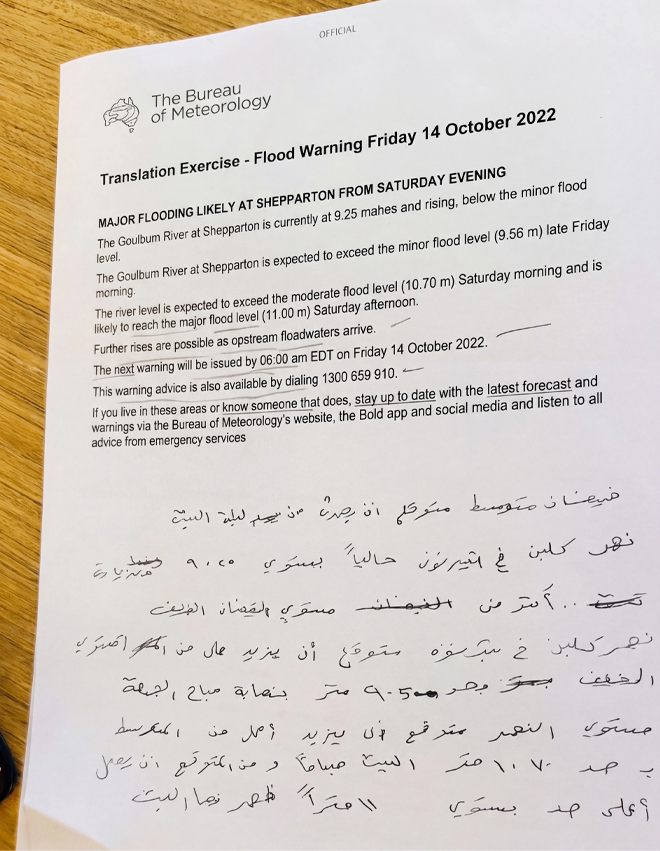
Figure 1: Example translation of a major flood warning completed by a participant in the 'Translating and Interpreting in Disasters' workshop. Image: Bureau of Meteorology
Agency learnings
The workshop provided an important platform, allowing community members to share perspectives and experiences of emergency communication practices and products directly with the responsible agencies. Agencies benefited from the engagement activity, gaining insights to inform service improvements and promote adaptive and more accessible communication strategies. Key takeaways for VICSES included a deeper understanding of which specific terms and concepts, frequently used in emergency warnings, are difficult to translate for certain language groups. VICSES staff also noted the importance of focusing on capacity development, to promote greater understanding of commonly used emergency management terminology. For the Bureau, benefits included a greater appreciation for engaging through existing community networks and how train-the-trainer methodologies can be used to foster community capability.
Participants contributed valuable suggestions:
- Engaging with community members across all levels, extending beyond formally recognised leaders, to ensure broad and inclusive participation.
- Maintaining ongoing partnerships with community connectors to foster trust and responsiveness to emerging community needs.
- Developing linguistic capacity within the community by disseminating accessible resources including glossaries and visual aids which are adapted for the needs of diverse audiences (e.g. digital glossaries).
- Providing ongoing education and support to empower community members in effectively accessing and using official emergency information resources, including centralised communication channels, such as national/regional websites, apps and hotlines.
- Prioritising capacity-building initiatives that draw upon and enhance participants’ existing experiences, skills and knowledge.
- Adopting interactive training formats that encourage active participation among community members
Advocates have emphasised the importance of developing more effective and ongoing communication and participatory relationships between multicultural communities and emergency management agencies (AIDR 2020; ECCV 2021). Establishing and maintaining partnerships with community leaders and connectors supports timely communication and can build trust between emergency response agencies and the wider community (Duckworth 2022). Additionally, this approach acknowledges the needs and resources that local communities have that can reduce the impacts of disasters (Ma et al. 2023). Recognising and harnessing these community skillsets is paramount for providing more effective and equitable disaster outcomes and promoting greater resilience among diverse groups (ECCV et al. 2023).
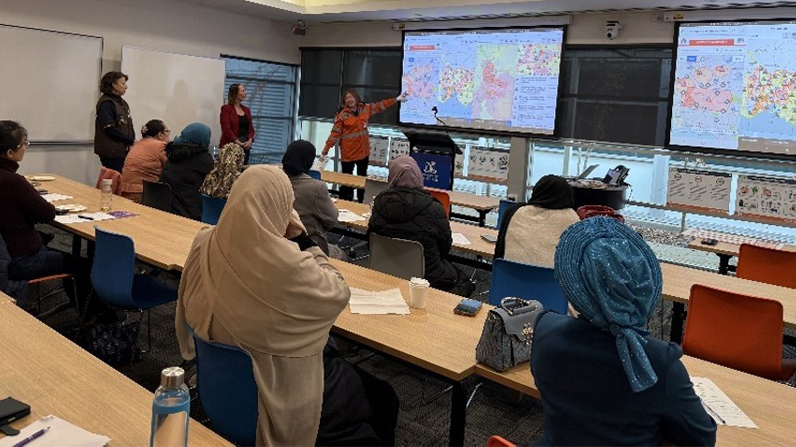
Figure 2: VICSES staff and volunteers demonstrating how to navigate and utilise the VicEmergency website. Image: Bureau of Meteorology
Agencies involved in the workshop have committed to using insights from the workshop to guide further engagement and capacity development across Victoria’s regional communities. The Bureau is building ongoing relationships with key partners who connect with and represent multicultural communities around Australia. Through initiatives including the Community Preparedness Program, the Bureau is collaborating with emergency management agencies and community organisations to share knowledge and build capacity with multicultural communities nationally. The aim is to enhance the accessibility and effectiveness of Bureau products and services – ensuring they reach all Australians, are clearly understood and support safe decision-making during severe weather events.
Conclusion
The Translating and Interpreting in Disasters workshop, alongside the broader Monash University T&I training program, is expected to enhance the capacity of local multicultural individuals to support others within their cultural and linguistic networks who may be at higher risk during disasters. Community engagement initiatives and resilience-building opportunities such as this are crucial to ensuring non-English speaking individuals and communities have equitable access to emergency information and warnings. By specifically targeting those who serve as community connectors, agencies can improve the accuracy of information relayed during emergency events, build relationships and reinforce trust and public confidence in official communications. Sustained investment of both time and money in community-led interventions is imperative for building robust and inclusive disaster management systems.