


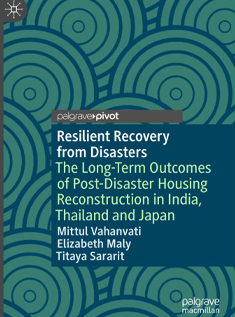
 Author
Mittul Vahanvati, Elizabeth Maly and Titaya Sararit
Reviewed by
Richard Mowll
Consultant
Published by
Palgrave Macmillan
ISBN: 978-981-97-8046-4
The effects and effectiveness of housing recovery programmes following major disasters is explored in this book using 6 major damaging events in India (2001 Gujurat Earthquake, 2008 Kosi River floods), Thailand (2004 Indian Ocean Tsunami, 2011 Ayutthaya floods) and Japan (1995 Great Hanshin Awaji Earthquake, 2011 Great East Japan Earthquake). As such, the case studies presented reflect low-middle income, upper-middle income and high-income countries, respectively. The review of the disaster effects was carried out in 2025, which provided between 14 and 30 years of effectiveness to be considered.
The results are well presented, demonstrating 5 significant factors that contribute to building resilience and capacities: a leading role of government, the role of recovery coordination, land- and settlement-planning and improving building standards, resource/assistance packages to households and sustained capacity building (of stakeholders). Conversely, the factors that hinder resilience were the negative effects of governmental top-down coordination, inadequate financial assistance to households, the shortfalls of market-driven programmes and a lack of capacity building beyond housing reconstruction.
The book outlines the complexity of leading large-scale housing recovery programmes after major damaging events and provides pointers to successful governance, policies and practices, which are relevant to the diversity of contexts covered by the 6 events reviewed. The analysis carried out is, necessarily, qualitative rather than quantitative, due to the nature of the research and the number of case studies available. The advantage of this is that it brings out the texture of learnings from each case study. It firstly identifies, then follows, a structured approach to the analysis, allowing for the breadth of recovery implementation and effects to be reviewed and understood.
The book is structured as if it were 5 academic journal papers, with an abstract at the start and references at the end of each chapter. This gives the book an academic feel but allows the reader to focus on the section of most interest to them. The 3-page conclusion provides a concise overview of the lessons learned.
The book is of value equally to practitioners and policy makers involved in planning or implementing recovery works as well as to academics interested in the outcomes of large-scale housing recovery programs.