

Australia has recently experienced a series of disasters that destroyed many homes and displaced many people. Different approaches to post-disaster shelter have been implemented in the wake of these events, including accommodation provided in hotels, caravan parks, social housing or ‘temporary villages’ using shipping containers and modular prefabricated dwellings (pods). While these initiatives have some positive outcomes, a range of problems are also evident, particularly the protracted nature of the displacement. For people without adequate insurance, or with limited options for relocation, and in an environment of housing shortages, access to permanent housing becomes uncertain and the makeshift solutions can have severe consequences. Given the increases in the frequency and magnitude of emergencies and disasters, living in such places is untenable. Further, the development of new building regulations such as the Bushfire Attack Level ratings to minimise disaster risk adds to costs and can impede access to permanent housing. There are few studies on shelter after disasters in Australia and this points to the need for in-depth research that can inform policy and practice.
Introduction
A range of natural hazards affect Australia and, given the influences of climate change and population growth, these have resulted in larger and more frequent disasters in recent times. The effects of such disasters on housing have been extensive. Housing is a basic human necessity and is largely an immobile, high-value asset. Housing is often the sector that suffers maximum damage in disasters (Lyons 2009). Displacement and loss of shelter compound the event and can have long-term effects on economic security, safety, social connectedness, health and wellbeing. Significant resources and many years are required for housing recovery. As such, resilient housing is vital to shelter and safeguard people.
This is reflected in the Australian context. To explore this, this study examines 2 major events of the summer bushfires during 2019–20, where more than 3,000 houses were destroyed (NHRA 2023) and the severe floods in New South Wales in 2022 where more than 15,000 houses were destroyed or damaged in the Northern Rivers region and in the Central West. In the most affected town of Eugowra, more than 80% of buildings including houses were damaged (NSW Audit Office 2024). Shelter provision after disasters is the responsibility of state governments and indicative recovery costs for the New South Wales floods are more than $300 million spent in less than a year for temporary housing (NSW Audit Office 2024).
This study explored the outcomes of these investments and efforts. It draws on the cases of the 2 nominated disaster events, discusses the typical approaches to shelter provision and analyses the achievements and challenges. A key argument is made that the primary preoccupation is with temporary shelter provision and there is limited attention to support long-term, disaster-resilient solutions for permanent housing that could reduce the need for continually providing short-term temporary solutions. Another option is to build into policy and practice a vulnerability paradigm that places the shelter needs of people at the centre so that post-disaster interventions do not exacerbate or create vulnerability and, instead, support resilience.
Methods
The findings are derived from a focused review of literature. An integrative review approach was used, which involved synthesising data from different sources (Kutcher and LeBaron 2022). For this study, scholarly and grey literature including media reports were examined. It was important to review sources such as reports, policy documents and news stories that offered current and extensive information on the issues beyond academic publications.
The literature was reviewed in a critical synthesis approach where the aim was to examine problem areas identified in the literature and develop a narrative from the synthesis of those areas. It also followed an evaluative research paradigm by assessing the actions of relevant stakeholders and the related overall condition of the shelter and housing sector in Australia. The critical synthesis literature review was analysed thematically by ascribing manual codes to themes that emerged from the identified problem areas. These were grouped and clustered according to the codes to generate the findings. This process followed a thematic analysis strategy (Braun and Clarke 2019; Caulfield 2019) by first gaining familiarity with the literature then coding and developing themes, which then allowed reviewing, defining and naming the themes.
A search of literature was conducted using Google Scholar using the terms ‘housing’ AND ‘disaster’ AND ‘Australia’. Results between January 2009 and March 2025 were included. Peer-reviewed and non-peer-reviewed literature was included given that there is an important body of grey literature to consider. Recent and relevant literature on the topic was limited and it was difficult to assess long-term outcomes of recovery after the 2019–20 summer bushfires and 2022 New South Wales floods. Therefore, the timeframe covered in this study stretches back to include the Black Saturday bushfires in Victoria in 2009. This allowed greater insight from the shelter recovery process. This paper serves as the background and foundation for future research as the outcomes of the recovery.
Overview of shelter approaches
A foundational publication by Quarantelli (1982) suggests 4 main forms of post-disaster shelter being emergency shelter, temporary shelter, temporary housing and permanent housing. Quarantelli’s definitions remain valuable in differentiating between ‘shelter’ and ‘housing’. The former implies a form of short-term accommodation allowing a protective space for sheltering and sleeping while the latter provides longer-term accommodation and has more space and provision for daily necessities. These definitions imply a continuum from a disrupted immediate post-disaster situation to a stable long-term condition. However, this is an idealised concept and, in actuality, the progression is rarely linear. Indeed, stable housing may not eventually be attained or it might take a very long time to achieve.
The term ‘shelter’ has been used by international humanitarian agencies in post-crisis situations to mean accommodation for affected populations (Davis 1978; Quarantelli 1982; UNDRO 1982). The term has been applied primarily in the context of developing countries but has wider relevance. Recent conceptualisations in Australia indicate that three main forms of post-disaster shelter are recognised. These are emergency accommodation, temporary housing (NSW Audit Office 2024) and permanent housing, but the term ‘shelter’ is not generally used. Charlesworth and Fien (2023) distinguish between the early and later stages of accommodation as ‘temporary shelter’ (the initial 4 to 6 months) and ‘temporary housing’ (expected to serve for up to 2 years). In reality, so-called ‘temporary’ housing has been required for a more protracted period (see Lucas 2022). Facility conversion to establish relief and evacuation centres in schools, gymnasiums and community centres is also a common emergency shelter option as these facilities are fairly widespread across Australia.
Key issues in emergency and temporary shelter
Emergency shelter in Australia is typically provided in hotels and motels (NSW Audit Office 2024), caravan parks and via rental subsidies paid to people in private rental accommodation (DCHDE 2021). There is no available evidence on the extent to which such arrangements progress to long-term permanent housing as typically envisioned, nor how many people transition into permanent housing. According to the NSW Audit Office (2024), a survey conducted after the 2022 floods in the Northern Rivers showed that almost half of the respondents in emergency accommodation thought they would never be able to return home, while a similar proportion of people were uncertain about such a prospect. Compounding this, in remote and rural areas of Australia there is often a scarcity of hotels and motels (Charlesworth and Fien 2023) that further limits the options for emergency accommodation.
Temporary housing includes short- and medium-term accommodation typically in caravans or ‘pods’ usually made from shipping containers or custom-made shelters (Watt 2023). These are generally provided by Australian governments and often in partnership with non-government organisations such as Habitat for Humanity and Australian Red Cross. This was the case after the 2022 floods and 2029–20 summer bushfires (Aubrey 2020; Australian Red Cross 2021; Claughton 2021; Minderoo Foundation n.d.). In the Northern Rivers, it was decided to build 11 temporary villages via a congregate sheltering arrangement, with 546 dwelling units spread across the villages (NSW Audit Office 2024). Nearly a year and a half after the floods, there were more than 700 people waiting for temporary housing. The temporary villages could not meet the need and people lived with friends or family, in emergency accommodation or experienced homelessness (NSW Audit Office 2024).
Temporary villages provide levels of functionality and possibility for recovery. Research by Charlesworth and Ahmed (2015) after the Black Saturday bushfires in Victoria in 2009 noted that temporary villages in bushfire-affected areas of Kinglake and Marysville were built with different communal facilities and in proximity to previous homes with access to social amenities. This enabled the communities to remain cohesive and provided a medium-term transitional solution for 18 months until permanent housing was built. While there were positive outcomes, there were also challenges. For example, people may not be accustomed to living in small dwellings in close proximity to other people and friction was inevitable. Despite the advantages, this cannot be a widespread solution because of the associated high cost and logistical demands as well as it not meeting the level of need required after large-scale disasters (NSW Audit Office 2024).
Following the Northern Rivers floods, there were issues of access and quality of post-disaster shelter and housing solutions. A key issue relating to temporary housing in pod villages was people’s eligibility and access to these programs. Submissions to the Independent Flood Inquiry (O’Kane and Fuller 2022) detailed how homeowners were not eligible if they had accommodation support through their insurance policies. This had major financial consequences for homeowners with mortgages who had limited access to housing programs as well as the financial burden of their mortgages while funding alternative accommodation. These financial pressures left homeowners with mortgages trapped in flood-affected homes while they waited for decisions on their insurance claims (Ross and Hannigan 2024). Significant insurance delays were reported in the Deloitte (2023) investigation into the insurance industry’s response to the floods. This report stated that there were over 34,000 open insurance claims related to property, vehicle and home contents that remained outstanding 12 months after the event (Deloitte 2023). These findings reflect the existing literature that suggests that insurance can be maladaptive when it fails to facilitate recovery (de Vet et al. 2019; O’Hare et al. 2016; Wamsler and Lawson 2011).
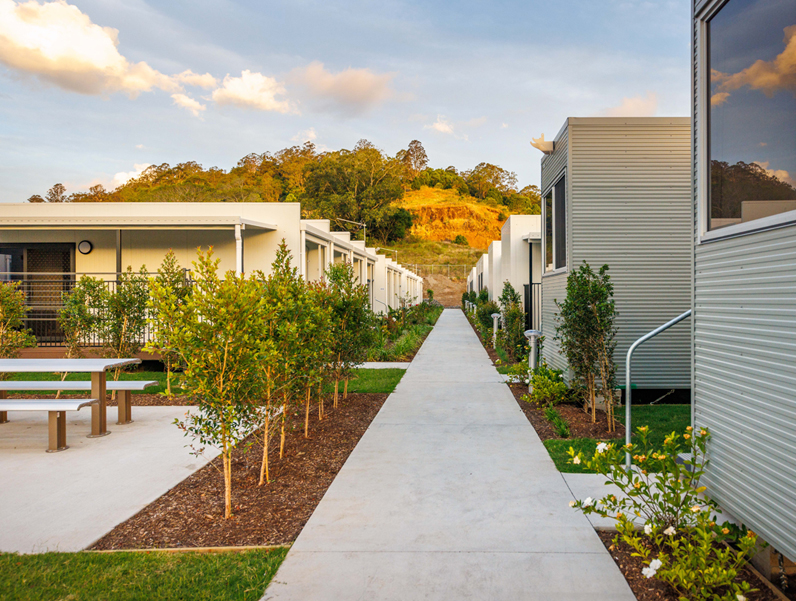
A temporary village with ‘pods’ in Lismore built after the 2022 floods.
Image: Courtesy NSW Reconstruction Authority (2024)
O’Kane and Fuller (2022) found that the limited availability of alternative housing options in the Northern Rivers meant that many people lived in flood-affected houses. While not completely destroyed, many of these houses were unsuitable for habitation. Multiple submissions to the Independent Flood Inquiry showed that people dealt with cascading problems like mould growth after homes had soaked up floodwater for prolonged periods or by being exposed to extensive rain damage (O’Kane and Fuller 2022). This presented a health hazard for the residents and they reported respiratory issues and emotional stress associated with living in such conditions (Archibald-Binge 2022).
The lessons from the Northern Rivers floods prompted a different approach following a later flood in 2022 in the Central West region of New South Wales. In this case, after the initial emergency period, an ‘At-Home caravan program’ was implemented where people were provided with caravans and subsequently followed by a pod on their property. This was done instead of building temporary villages. It is reported that even people who were renting were provided this support in negotiation with the landlord or other property owner (NSW Audit Office 2024; NSW Government 2024a). This approach appears to have had positive outcomes as evident from similar initiatives of pods provided after the 2019–20 summer bushfires (Charlesworth and Fien 2023). According to an evaluation of the flood housing response, the outcomes after the fires were better than those in the Northern Rivers floods (NSW Audit Office 2024). However, it should be acknowledged that the scale of the disaster and consequent shelter needs were smaller and, thus, more manageable.
It is not clear whether all the affected people in the Central West could be supported with the 130 pods provided (NSW Government 2024b) or whether all the people in caravans could make the transition to pods or permanent housing. Caravans can only accommodate 2 to 3 people; they are not very suitable for families and are generally unsuitable for living in for an extended period. Even pods are not meant for habitation for more than a couple of years. According to Charlesworth and Fien (2023), pods are not habitable for more than a few months. Yet media reports document that people lived in caravans and temporary housing for several years after the summer bushfires (Lucas 2022; May 2022) and many people did not even receive temporary housing support after the Northern Rivers floods (NSW Audit Office 2024). The temporary villages in the Northern Rivers are expected to be dismantled after 5 years (NSW Audit Office 2024), which is well beyond the desirable period for this type of accommodation.
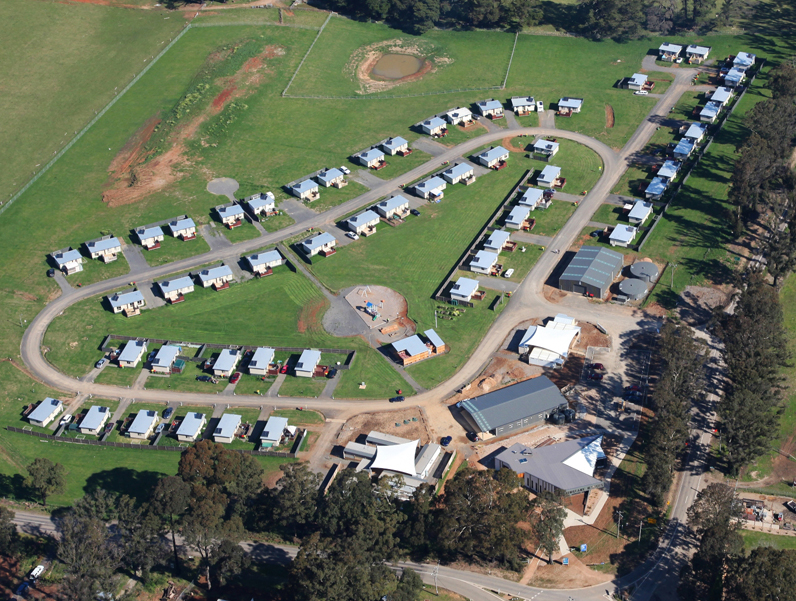
A temporary village in Kinglake, Victoria, was built after the 2009 Black Saturday bushfires.
Image: Courtesy of Peter Johns (2010)
Various other issues are also evident. Insurance payouts for temporary accommodation tend to cover a short period, beyond which households face prospects of homelessness. Even with rental support from insurers and/or governments, there is often inadequate supply and availability of rental properties (Fitzsimmons 2021). Finding rental properties in areas that have been devastated is obviously a challenge, one that is exacerbated by ongoing rental shortages across Australia.
An intractable issue is the high associated costs (Heffeman et al. 2025) of elaborate processes of procurement, production, transportation, installation, removal, storage and maintenance of temporary housing such as pods. The Australian Government has embarked on a modular shelter program with the company Humanihut with a budget of 14.2 million (Watt 2023). These housing products provide a better short-term living environment with more space and amenities. However, whether this is justifiable in terms of cost and the potential for progression to achieve permanent, resilient housing is not yet known.
Availability of materials and tradespeople in the aftermath of a disaster are also key challenges (Charlesworth and Fien 2023; Tondorf 2022). Without the required numbers of qualified people to complete works, the recovery process is slow and leaves disaster-affected people in uncertainty. In the temporary housing program after the 2022 floods, $350 million was originally allocated to the response and recovery program. However, it required an additional $88 million and, even then, it could not cater to all the people in need of temporary housing (NSW Audit Office 2024). Temporary villages are indeed costly and cannot be a sustainable solution over the long term (Heffeman et al. 2025), especially with the growing incidence of severe disaster events.
Given the limited evidence on shelter recovery in Australia, many questions arise. How do people manage their shelter recovery? What is their trajectory towards permanent shelter solutions? What are the lessons for future shelter recovery policies and practices? Such questions, particularly in relation to those people experiencing poverty and marginalisation, are central to understanding social vulnerability (Fordham et al. 2013) in the post-disaster context.
Prospects for permanent housing
Permanent housing reconstruction is usually undertaken by homeowners with insurance funding, sometimes supplemented by grants from government and non-government organisations (Australian Red Cross 2021; Claughton 2021; NBRA 2020). However, there are widespread reports of difficulties negotiating with insurance companies, especially at a time when people are traumatised (Byrne 2024; Eriksen et al. 2020). There are also people who have insurance but then they learn it is inadequate (Fitzsimmons 2021). Charlesworth and Fien (2023) characterised this as ‘privatisation of housing’ and a ‘replacement recovery’ approach. Such an approach entails that insurance companies only pay for the cost of replacement of the destroyed house but not for any relocation cost or for ‘building back better’ (Clinton 2006; UNDRR 2015) to increase resilience to future disasters (Heffeman et al. 2025). After a disaster event building codes and standards are often changed to improve future resilience, which incurs extra costs for rebuilding that insurance companies may not cover. In other words, the insurance payouts can only assist to replicate pre-existing conditions of vulnerability that led to the destruction of the house in the first place.
The concept of ‘building back better’ for resilience to future events has been widely used since being posited by the former President of the United States and the UN’s Special Envoy for Tsunami Recovery (Clinton 2006) after the 2004 Indian Ocean Tsunami. The concept is also espoused in the United Nations Sendai Framework for Disaster Risk Reduction 2015-2030 (UNISDR 2015) as one of its 4 priorities. However, the goal of ‘building back better’ has been elusive in Australia because of the market-driven paradigm of post-disaster recovery led primarily by the insurance sector, as also noted by (Heffeman et al. 2025).
An example of this is the Bushfire Attack Level system that came into place after the 2009 Black Saturday bushfires to ensure safety of future housing. Proposals for building new houses are assessed for their bushfire risk according to factors such as location and environment and then measures in relation to building design, construction and materials need to be incorporated according to the level of risk. Generally, the higher the risk, the more expensive the measures. For people rebuilding, this can add a significant financial burden (Fitzsimmons 2021). As a new system following the Black Saturday bushfires, there were reports that expert assessors were not available and assessments were not always accurate (Charlesworth and Ahmed 2015).
Exceptions are sometimes made for households that have a low income and cannot rebuild their homes. However, even here, problems can arise as mentioned by a recovery worker in a panel discussion at a postgraduate course in the University of Newcastle. After the summer bushfires, 3 families that had lost their homes were promised new houses by the NSW Government. However, after waiting for almost 5 years they had not received a response and were still living in pods. The area had a high Bushfire Attack Level rating, but the families had long connections with the locality and did not want to move and, thus, lived there at risk to future bushfires.
Research on the 2022 floods demonstrate the critical dilemma faced by flood-affected households navigating insurance (Mortimer 2024). In the aftermath of the floods, significant delays in insurance payouts left many homeowners in limbo: they were unable to fund their rebuild or relocate out of the floodplain. Many remained financially tethered to their land due to ongoing mortgage obligations, despite their homes being uninhabitable or damaged. Some flood-affected residents did not have the means to self-fund permanent relocation and their land and damaged homes became a source of financial entrapment (Mortimer 2024). Compounding this, government grants often excluded those with insurance coverage despite widespread reporting of lengthy delays and disputes in accessing those payouts (Deloitte 2023). These dynamics expose issues with the centrality of insurance in Australia’s disaster governance arrangements (Eriksen et al. 2020). When insurance mechanisms fail to support timely and equitable recovery they function as instruments of residual risk transfer that benefits institutions while exacerbating household vulnerability (van den Honert and McAneney 2011). Such systemic failures reinforce prolonged displacement and inhibit pathways to long-term recovery.
For people whose home has been destroyed, they must continue to live on the disaster-affected block in order to obtain insurance support even though this exposes them to hazards. It is also likely that the market value of their land has decreased in the wake of the disaster. Without financial and other incentives to relocate to safer land, their vulnerability is perpetuated. Nonetheless, there are studies that show that despite the initial decline in market value, for example after the 2019–20 bushfires and the 2011 Brisbane floods, property prices had bounced back within a few years (Bendel 2025). With the scarcity of housing supply and high demand in Australia, the market seemed to adjust despite the potential future hazard risk. In the interim, as evident after the 2022 floods, because of the initial drop in house prices, large numbers of houses in affected areas were purchased at low prices (Gilmore and Naylor 2023). If these properties become rental housing, it can lead to renters living in high-hazard areas. This can exacerbate the burden of vulnerability being borne by people of lower socio-economic status (Lee and Van Zandt 2019). The permanent housing sector is primarily market-driven (Pawson et al. 2020). Governments and institutions are minor housing providers and do not have sufficient resources to respond to a crisis-driven housing need. They are reliant on the private sector to build housing and, as Australia is experiencing a chronic shortage of tradespersons and building materials (Build Australia 2023), it makes the provision of adequate housing all the more challenging.
The NSW State Government Resilient Homes Program (NSW Government n.d. a) developed after the 2022 Northern Rivers floods was created to help people into permanent housing.
There are 3 streams:
- Home buyback: The NSW Government offers to buy houses that are assessed to be in an area of high flood risk with support to the homeowner to access new land and housing elsewhere. More than 2,000 homeowners were eligible (MacKenzie 2024), however, an assessment reported 4,055 houses as uninhabitable (Smith 2022). Additionally, new homeowners, even if they had purchased a house in a disaster-affected area, are not eligible (Gilmore and Naylor 2023), which means that they remain exposed to future high-risk hazards. It is not clear if the buyback scheme addresses the problem adequately. A large-scale buyback scheme can be challenging and applicants need to wait for an extended period as was the case after the 2022 Northern Rivers floods (O’Kane and Fuller 2022).
- Home raising: The NSW Government provided up to $100,000 to homeowners in eligible areas to raise their house above flood level. However, flood level thresholds are increasing and repeat floods in Lismore and other flood-prone areas indicate that people can no longer live in low-lying areas even if their houses were raised on stilts in response to previous floods. The 2022 floods were more than 14 metres high and it is possible that future floods will result in higher river levels and greater areas of inundation (Siossian 2022). Even if a house is above flood level, people may become isolated inside the house and disconnected from utilities, food and other supplies. This is also the case where houses are built on raised mounds of land (particularly in farming locations within NSW river valley regions) and became isolated during flooding that cuts off road access. Thus, the long-term sustainability of house raising can be questioned.
- Home retrofit: Up to $50,000 is available to homeowners to repair or retrofit their affected property with flood-resistant construction and materials. If repair/retrofit costs exceed this amount and a homeowner does not have access to additional funds, it can lead to a difficult situation. Also, Australia is facing significant problems with the supply of building materials and labour (Build Australia 2023). After the 2022 NSW floods, there was an increased demand for materials and labour (Charlesworth and Fien 2023; Lucas 2022; Residential Tenancies Authority n.d.) and an escalation of prices (Lucas 2022). This is applicable for building both temporary and permanent housing. Hence, the feasibility of this approach may be limited.
Despite some shortcomings, the NSW Resilient Homes Program is the first of its kind and represents an attempt to address the issue of shelter after disaster events. While the program targets the Northern Rivers region, there is a need for similar initiatives in other parts of Australia that experience high-risk hazards. This affords an opportunity to learn how such initiatives can be planned and streamlined.
Discussion
The provision of shelter and housing during different post-disaster stages brings into focus the vulnerability paradigm, which attributes the negative effects of disasters on systemic and structural factors such as poverty, marginalisation and inequality, also known as ‘social vulnerability’ (Fordham et al. 2013). As highlighted by (Scandlyn et al. 2013, p.43), ‘With few exceptions, the poor and marginalised are most vulnerable to disasters, whether they live in rich or poor nations’. This is reflected in Australia in relation to shelter after disasters. For example, in the Victorian coastal town of Mallacoota ravaged by bushfires in 2020, Lucas (2022) reported that elderly people were living in makeshift shelters for more than 2 years. Similar predicaments were faced in other bushfire-affected areas by elderly and retired people due to lack of rental options from insurance companies (Fitzsimmons 2021). Fitzsimmons (2021) reported that people in local indigenous communities experienced housing recovery hurdles due to inadequate insurance and limited access to construction services. Charlesworth and Fien (2023) noted limited housing options for overcrowded communities and the NSW Audit Office (2023) recorded inadequate and inappropriate engagement approaches.
Another area of concern relates to renters displaced by emergencies and disaster whose long-term housing needs are often unaccounted (Heffeman et al. 2025). Most housing support is targeted at property owners. For example, after the 2022 floods in the Central West, pods were available for people who owned private property. For renters, caravans were provided if they were able to receive permission from the landlord (NSW Government 2024a). Despite the problems of living in caravans long term, people lived in such arrangement for many years. The Queensland Government has a provision for renters in crisis (Residential Tenancies Authority, n.d.) but this is only for a period of 2 weeks (Queensland Government 2023). People who are unable to secure rental accommodation within this time face uncertainty and this can be exacerbated by a shortage of affordable and available rental housing (AHURI 2022). There is minimal discussion on the displacement experiences of people who were homeless prior to the disaster events. The Australian Government has identified that there is a housing supply problem (e.g. Sheth-Patel 2024) and the urgent provision of adequate housing after emergencies and disaster adds to the problem. Lucas (2022) reported that, in regional areas, there is a ‘property boom’ and high rental and building costs make it more difficult for people experiencing poverty to recover after disaster events.
The Resilient Homes Program serves 7 local government areas in the Northern Rivers that were affected by the 2022 floods. However, a much wider regional spread can be expected to be affected by future floods. Large-scale planning seems to be missing. Indeed, a lack of state-level planning and lessons-sharing was found in the evaluation of the flood housing response, including the lack of a strategy to meet temporary housing demand and long-term transition from temporary to permanent housing (NSW Audit Office 2023).
Another issue was the bureaucracy involved in housing support processes. For example, the Resilient Homes Program factsheets details the many requirements to meet eligibility criteria and access support (e.g. NSW Government n.d. b). Experiencing a disaster can be traumatic and many people may be in a crisis state long after the disaster. Bureaucratic processes can be challenging in such circumstance and may be associated with processes of procuring housing materials, transport and installation as well as recruiting skilled workers, which can contribute to delays (Charlesworth and Fien 2023; Fitzsimmons 2021; Lucas 2022; NSW Audit Office 2023).
Conclusion and further research
Australia experiences significant challenges in designing and delivering effective post-disaster shelter programs. A house is usually the most expensive asset someone owns or inhabits and rebuilding after a disaster is an expensive process. Given the pressures of housing supply scarcity, escalating costs and supply shortages, there will likely be an increase in the numbers of people displaced by disasters in the future.
To improve the safety and wellbeing of people and communities, significant reforms are needed to the systems and processes to provide short-term shelter and long-term housing for people affected by disasters. Some of these reforms need to be enacted by governments, including investment in disaster preparedness, response and recovery phases and streamlining bureaucratic processes. Some reforms must be enacted by the private sector (potentially via regulation), particularly the insurance sector, to fairly and adequately protect against the social and economic effects of disasters. Some changes will be required of individuals, families and communities that face difficult questions about the level of disaster-related risk they live with and their values of place and connections to community. It should not be assumed that people have choices in such scenarios. For many people, there are economic, social and other constraints that limit their capacity to mitigate risks. There are also a range of complex systems and determinants that influence the capacity for effective shelter and housing responses. These include the general housing market as well as levels of poverty, discrimination and health. The complexity of this situation, and the understanding required to improve housing outcomes for people displaced by disasters, mean that further research is needed to inform evidence-based policy and practice.