

 Author
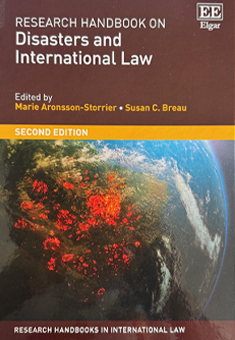
Edited by Marie Aronsson-Storrier and Susan C. Breau
Reviewed by
Steve Glassey
University of Central Lancashire
Ruth Oakley
Independent Researcher
Published by
Edward Elgar Publishing
ISBN: 9781803924205
Disasters and International Law presents a comprehensive and intellectually sound examination of international disaster law, drawing together contributions from 26 authors with varied academic backgrounds and perspectives. Edited by Marie Aronsson-Storrier, and Susan C. Breau, this second edition explores the conceptual, doctrinal and critical dimensions of the field and offers in-depth engagement with the human-nature relationship, constructions of risk, structural vulnerability and the limitations of existing legal frameworks.
Thought-provoking chapters include an acknowledgment by Marie Aronsson-Storrier about the ‘human-nature’ dualism in the ‘west’, which has been brought into instruments and language on disaster risk and management, with indigenous views being essential to be not a countermeasure but core perspectives that are integrated. The issue of credibility and its relationship with law-making and the testimonial justice theory is examined in light of indigenous views often being considered fringe or alternative. This ties in with the chapter by Scott Williams in which he explores the concept of risk and the ‘dishonourable harvest’ with questions around ‘property’ and their ‘bundles of rights’ and how these drive international risk reduction law while, at the same time, not recognising that these concepts permit ‘violence’ through lack of recognition and protection for nature. This is done with a focus on changing our environment rather than looking at ourselves.
Liam Bagshaw discusses how law, including international disaster law, is a mechanism by which vulnerabilities are concreted, as is wealth, power and influence, to continue hegemony of particular values that serve those who stipulate them. This makes a natural connection with Johns Hopkins' examination in his chapter of why many Pacific Island states are reluctant to enter into international agreements. This puts context around why smaller nations are often alert to how international disaster law has been used and remains a potential mechanism of exploitation. Hugo Cahuenas, Laura Carrion and Juan Felipe Idrovao Romo provide valuable contributions on gender-based violence and human mobility. They explain why women are less likely to leave disaster zones and how laws, among other factors, play a part in perpetuating these vulnerabilities.
This handbook is aimed at legal researchers and postgraduate students specialising in international disaster law. Only one contributor acknowledges practical experience in disaster management operations (Australia), which underscores the work’s orientation towards theoretical legal scholarship rather than applied practice. This academic focus manifests as a relative paucity of practical legal guidance for students and emergency management practitioners seeking operational insights. The editors have positioned this as a research handbook rather than an instructional textbook for entry-level students or field practitioners.
An omission is the absence of any substantive treatment of animal disaster law, despite its growing political and social prominence across multiple jurisdictions, including the United States, Australia, New Zealand and Italy. This absence is noteworthy given that, when the New Zealand Government sought public submissions on the Emergency Management Bill 2004, the majority of respondents identified the inclusion of animal disaster law provisions as the most important legislative priority.1