

Since 1986, the Australian Journal of Emergency Management (AJEM) has evolved alongside the emergency and disaster sectors in Australia and Aotearoa New Zealand. Originating as The Macedon Digest, it has transitioned from a newsletter to an outward-facing, internationally recognised scholarly journal. Its content has shifted from practice-based reporting to evidence-based research, evaluation and policy analysis and from a civil-defence focus to a community shaped, resilience-oriented approach. AJEM plays a significant role in leading the conceptual development of emergency and disaster management.
Background
In 1986, the Australian Civil Defence School (then part of the Australian Natural Disasters Organisation) launched The Macedon Digest as part of a growing national effort to formalise emergency management in Australia. The publication was a practitioner-focused newsletter, providing a platform to share lessons learnt from disasters and to circulate policy, training and operational insights.
Over time, The Macedon Digest expanded in scope and sophistication. From 1991, The Macedon Digest was co-titled as the Australian Journal of Disaster Management, reflecting knowledge sharing and institutional changes, including the transition of the Australian Civil Defence School to the Australian Emergency Management Institute (AEMI) on 1 January 1993. In December 1995, the publication was formally registered as the Australian Journal of Emergency Management, aligning closely with AEMI’s training and doctrine. It became a nationally recognised journal combining practitioner insights with research and policy analysis.
As emergency management evolved into a recognised discipline encompassing mitigation, preparedness, response and recovery, the need for a formal, peer-informed approach to knowledge generation became evident. By the early 2000s, the sector experienced increased academic involvement and research funding, alongside increased integration and multi-agency coordination. This period marked the expansion of emergency management into an established policy and research domain.
Peer review became a defining feature of AJEM’s research contributions. The journal currently draws on a global network of around 250 referees from academia, consultancy and practice, spanning Australia, Aotearoa New Zealand, Canada, Europe, Indonesia, Japan, the United Kingdom and the United States. The expertise and voluntary commitment of these reviewers over many years have maintained the journal’s standards and the quality of its research.
Decadal journal anniversaries provide opportunities to reflect on progress and review trends in content, style and contributions (Gold and Hein 2026). As a hybrid industry-research publication, the journal bridges research and sector knowledge and informs evidence-led practice in the emergency management sector. This 40th anniversary year is a timely opportunity to reflect on and document AJEM’s catalogue. This paper examines changes in the authorship, content, style and character of articles in The Macedon Digest and AJEM since 1986.
Analysis of the catalogue
The catalogue 1986 to 2025 comprised 158 issues. Publication occurred 4 times per year with the exception of 1990 and 2009 when only 3 issues were produced. Using records of 158 issues (Table 1), 1,755 published articles were coded into a database of year, volume, issue, month, special issue status, title, article type, author organisation, author gender, country of authors, country of content and hazard type addressed in the article.
Articles corresponding to research papers or features, reports and ‘news and views’ were included in the database. While the purpose, structure, identity and content of the publication changed when AJEM was established in 1995 (Table 1), we applied experiential knowledge to equivalise articles from the earlier newsletter format of The Macedon Digest for coding. In all issues, articles advertising training courses, letters to the editor, visits, staff changes, library acquisitions, conference announcements, communiqués, events calendars, workshop and conference announcements, book reviews, opinions, viewpoints, forewords and vales were excluded from coding.
Basic statistics were used to identify trends in coded parameters over 4 decades. Trends in article titles were identified using a word cloud generator (wordclouds.com) where the most frequently occurring words in article titles appear larger in the word cloud. The words ‘disaster’, ‘disasters’, ‘emergency’, ‘emergencies’, ‘Australia’ and ‘Australian’ were excluded from display in the word cloud because they are common qualifiers for article topics. The word ‘management’ was retained because it was used in many contexts outside the term ‘emergency management’.
Table 1: Summary of publication naming, publication management and archive locations 1986-2025.
| Years and volumes | Naming | Publisher | Archive obtained from |
| 1986 (Volume 1) to 1989 (Volume 4) | The Macedon Digest | Australian Counter Disaster College | Australian Institute of Disaster Resilience Macedon Digest Collection page https://knowledge.aidr.org.au/collections/macedon-digest |
| 1990 (Volume 5) to 1994 (Volume 9) | The Macedon Digest1 | Australian Counter Disaster College (1990–93) Australian Emergency Management Institute (1993–94) |
Informit Database2 https://search.informit.org/journal/macdig |
| 1995 (Volume 10) to 2012 (Volume 27) | Australian Journal of Emergency Management3 | Australian Emergency Management Institute | Informit Database https://search.informit.org/loi/ajem/group/d1990.y1999.m11 |
| 2013 (Volume 28) to 2025 (Volume 40) | Australian Journal of Emergency Management | Australian Emergency Management Institute (2013–15) Australian Institute for Disaster Resilience (2016–25) |
AIDR Knowledge Hub - Australian Journal of Emergency Management4 https://knowledge.aidr.org.au/collections/australian-journal-of-emergency-management |
1. The Macedon Digest was co-titled The Australian Journal of Disaster Management between 1991 and 1994.
2. These volumes are also available via the links on the Australian Institute of Disaster Resilience Macedon Digest Collection page. https://knowledge.aidr.org.au/collections/macedon-digest
3. In 1995, the publication transitioned from a newsletter format to a quarterly journal publication with editorial policies and peer-reviewed contributions.
4. These volumes are also available on the Informit database. https://search.informit.org/loi/ajem/group/d1990.y1999.m11
Articles have covered a range of hazard types over 4 decades
We coded 18 specific hazard types from the 1,755 published articles (Table 2). The most commonly covered hazard types were bushfire, flood, technological and security hazards (including terrorism and nuclear attack), earthquake, health and disease (including biosecurity), cyclone and tsunami. Hazard types covered in only one or 2 articles included tornado, asteroid impact and dust storm. Overall, the ‘all-hazards’ category constituted over 60% of the content of articles (Table 2). This reflects the integrative nature of the emergency management sector and the aims of the journal.
The all-hazards category also dominated the content of articles in each decade (Figure 1). All-hazards articles capture content that applies in any hazard scenario, associated with broad topics such as recovery, emergency services training, operations, policy, strategy and organisational decision-making, disaster risk reduction, communications and warnings, search and rescue, lessons management, community engagement and preparedness, vulnerable groups, volunteering, education and qualifications, economics, disaster resilience, diversity and inclusion and animals in emergencies, among others.
Articles specifically about flood, bushfire, cyclone, tsunami, earthquake, coastal, health and disease, technological and security, and landslide hazard types persisted through the decades, but changed in prevalence. This is likely in response to major disaster events prompting post-event analysis, inquiry and research or in response to broad strategic, policy and funding influences.
Between 1986 and 1995 there were 26 articles (9%) about floods, covering events in Gippsland, Mitchell River, Rockhampton, Benalla, Western Queensland and Bangladesh, but also articles about floodplain management and flood warnings. There were 20 articles (7%) about earthquake covering events in Newcastle, California and Iran, but also the emerging topic of seismic risk assessment and mitigation (Figure 1).
Between 1996 and 2005, technological and security hazard articles were prevalent (Figure 1). There were 51 articles (12%) about security-related topics such as terrorism (including a special issue on counter terrorism in 2005), Hazmat response and critical infrastructure protection. There were 36 articles (8%) about flood, covering flood events in Katherine, Wollongong, Nyngan, Cloncurry, New Zealand and Bangladesh and articles on flood-risk assessment in the Hawkesbury-Nepean catchment, flood warning, floodplain management, community recovery, evacuation, flood mitigation and flood insurance.
Between 2006 and 2015, bushfire was prevalent (Figure 1). There were 83 bushfire articles (20%) covering operational and community safety and recovery aspects of the Black Saturday bushfires. Alongside these were broader articles about bushfire risk assessment, community preparedness, firefighting, land-use planning, recovery and animal welfare; some of which drew from research and practice evidence from the Black Saturday bushfires. There were 26 flood articles (6%) covering integrative aspects of flood-risk management, flood mitigation, flood warning systems, lessons learning from individual events (including the Dungog flash flood) and community preparedness. In this decade there were also 16 articles (4%) about earthquake, including several about aspects of the 2011 Canterbury earthquake in Aotearoa New Zealand.
Table 2: Hazard types covered in all published articles between 1986 and 2025.+++
| Hazard type | Total articles | % |
| Bushfire | 220 | 12.5 |
| Flood | 123 | 7.0 |
| Technological and security | 72 | 4.1 |
| Earthquake | 63 | 3.6 |
| Health and disease | 58 | 3.3 |
| Cyclone | 48 | 2.7 |
| Tsunami | 26 | 1.5 |
| Landslide | 14 | 0.8 |
| Coastal and marine | 13 | 0.7 |
| Storm | 10 | 0.6 |
| Heatwave | 9 | 0.5 |
| Structural fire | 7 | 0.4 |
| Volcano | 4 | 0.2 |
| Drought | 2 | 0.1 |
| Tornado | 2 | 0.1 |
| Asteroid | 1 | 0.1 |
| Dust storm | 1 | 0.1 |
| Hurricane | 1 | 0.1 |
| All-hazards | 1,081 | 61.6 |
Bushfire continued as the most prevalent hazard type between 2016 and 2025 (Figure 1). In this decade, 93 articles (16%) covered aspects of Black Saturday as well as other events including the 2013 Blue Mountains bushfires, Wye River, Sampson Flat, the Hazelwood mine fire and the 2019–20 bushfire season. Bushfire articles also continued to cover integrative topics such as land-use planning, community recovery, mental health, community planning, bushfire risk perception, gender and bushfires, animal welfare, cultural burning, indigenous land management, fire danger ratings, technological advances in fire detection and firefighting, operational and organisational decision-making and child and youth participation in bushfire risk reduction, among others.
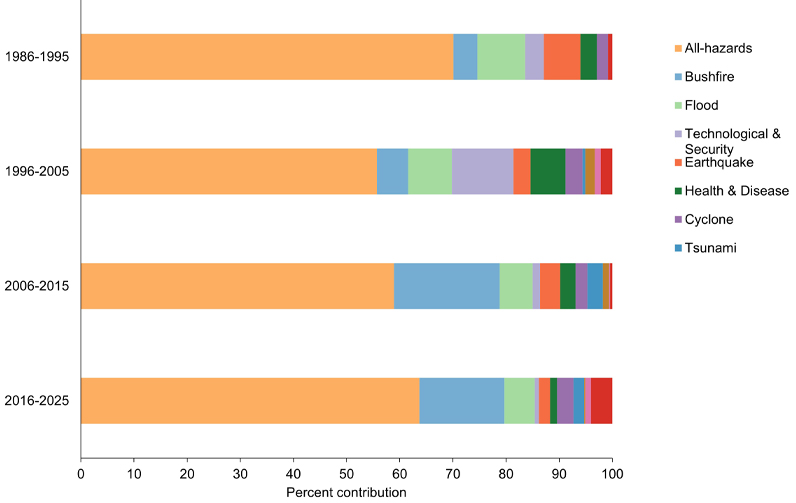
Figure 1: Hazard types addressed in all articles (news and views, reports, research) across 4 decades.
Contributions from academia, emergency services, government, community and industry were consistent
Commensurate with the aims of the journal to advance knowledge and practice to strengthen disaster resilience and emergency management in Australasia, contributions across all decades consistently came from academia, emergency services, government, not-for-profit and industry-affiliated authors (Figure 2). In many cases, article authorships were collaborations between groups: 10% of all articles were co-authored by combinations of academia, emergency services, government, community and industry groups. The hybrid research and practice focus of the journal remains a strength and the journal is uniquely positioned to bring together academic, practice and policy perspectives.
The most prevalent article topics changed over 4 decades
Management dominated article titles across all decades (Figure 3). In article titles, management was used as a noun (the act, art or manner of controlling, organising or handling something). Occurrences of the word ‘management’ were often as ‘emergency management’ or ‘disaster management’, which aligns with the disciplines and body of knowledge the journal represents. Other occurrences of the ‘somethings’ being managed varied widely as represented in article titles including risk, incident, recovery, evacuation, hazards, floodplain, flood, media, lessons, knowledge, waste, bushfire, land, public health, resource and volunteers. These usages often qualify a specific setting for management, such as in schools, specific locations, specific events or hazard types and aspects of emergency management such as recovery, operations or policy.
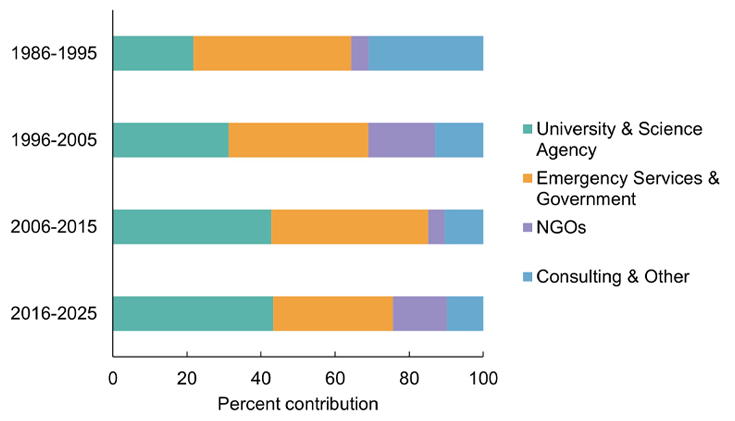
Figure 2: Author affiliations for all article types across 4 decades.
NOTE:
‘University & Science Agency’ includes CSIRO, Geoscience Australia and overseas-based science agencies.
‘Emergency Services & Government’ includes state emergency services agencies, state and federal agencies, local government, AFAC and AIDR.
‘NGOs’ include not-for-profits and Australian and international community organisations and committees.
‘Consulting & Other’ includes consultants, companies and the early Australian Counter Disaster College and Australian Institute for Emergency Management authors.
Alongside this persistent theme of management, the prevalent article titles changed across the decades. Between 1986 and 1995, titles most frequently conveyed an international, health, recovery, flood, planning, natural, community, earthquake, response and services focus (Figure 3a). Between 1996 and 2005, titles most frequently conveyed a community, risk, recovery, flood, natural, response, services, mitigation and education focus (Figure 3b). Between 2006 and 2015, titles most frequently conveyed a risk, community, resilience, bushfire/fire, response, preparedness, planning and social focus (Figure 3c). The emergence of resilience and community-centred practice was cemented between 2016 and 2025 where titles had a resilience, community/communities, risk, recovery, bushfire/fire, planning, preparedness and response focus (Figure 3d). However, it is important to note the full range of less frequently appearing words from article titles (Figure 3), which highlights the depth and breadth of topics covered within the journal.
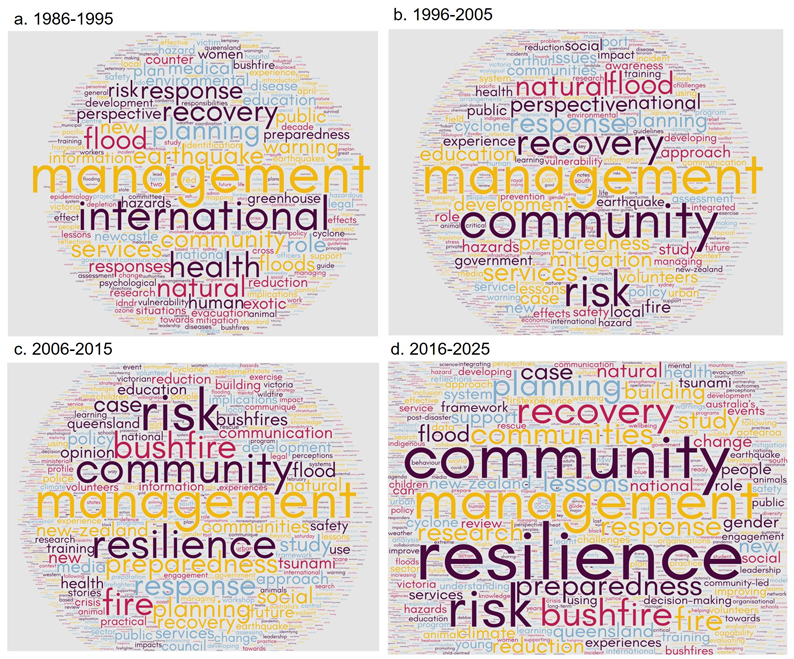
Figure 3: Word clouds showing the most prevalent topics in journal articles across 4 decades.
Larger words represent more frequent occurrences of words in article titles, taken from news and views, report and research article types.
Contributions by male and female authors change over 4 decades
Up until 2012, male authors dominated journal contributions across research, reports and news and views article types (Figure 4). In 1989, there were no contributions by female authors to The Macedon Digest (Figure 4). Contributions by female authors trend upwards until 2012 after which contributions by female and male authors become relatively more even, although contributions by female authors slightly outnumber contributions by male authors (Figure 4). Female participation in the emergency services sector has changed markedly since 1986. In 1996, Ruth Wraith asked in AJEM ‘Women in disaster management: where are they?’.
Ruth showed that the employment profiles of Emergency Management Australia and 4 State Emergency Services were dominated by men and that the percentage of women undertaking formal training in emergency management through AEMI was approximately 5% (Wraith 1996). Almost 30 years later, Stephanie Andradie and Cassie Lindsey reported in AJEM that women’s participation in the emergency management sector was 26.5%, up from 22.5% in 2018, with 37.6% representation in general manager roles, up from 25.6% in 2018 (Andrade and Lindsey 2023). Similarly, female participation in the university sector, and by implication in research, has increased markedly since 1986 (White 2003; Calderon 2022). The increase in female authorship of AJEM articles likely reflects this general sectoral change.
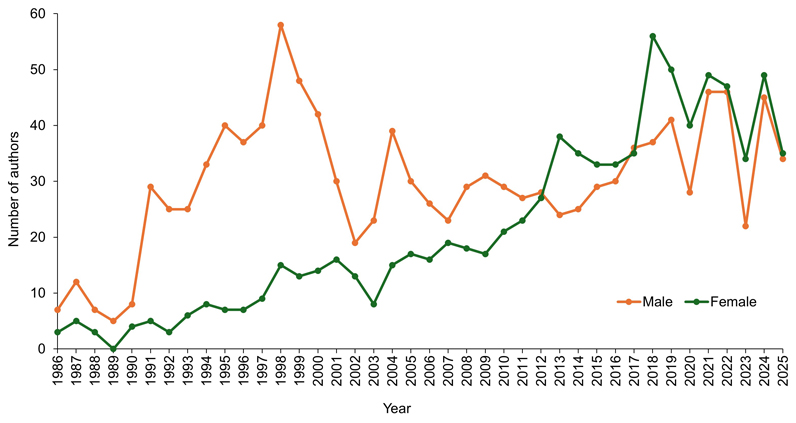
Figure 4: Gender of authors contributing to all article types 1986–2025.
The increased contributions by female authors between 2016 and 2025 is, however, largely in the non-research news and views article type (143 male authors, 208 female authors). This suggests a higher contribution by institutional and government-employed communicators where females generally outnumber males in the profession, particularly in early career stages (Media I 2025). Over the same decade, contributions of research articles and reports by male and female authors remained relatively even (research articles 172 male authors, 176 female authors; reports 50 male authors, 44 female authors).
Most content was about the Australian sector and most authors were from Australian institutions
The majority of articles published in the journal were about issues, events, practices and programs in Australia (Table 3). Articles about events and practice in other countries were contributed most frequently from Aotearoa New Zealand, United States and the United Kingdom (Table 3). Between 1986 and 2025, a total of 3,233 authors contributed to the journal. Most were aligned with Australian institutions (Table 3). This is to be expected because the journal aims to capture research, practice and news from, and about, the Australasian emergency management sector. However, between 1986 and 2025, content about aspects of emergency management in 45 countries was represented in the journal, contributed by authors from 29 countries. This reflects the similarities in emergency and disaster management that occur worldwide and the collaborations authors in Australia have with international colleagues.
Table 3: Country or area of article content and authors of all article types 1986–2025.
| Hazard type | Total articles |
% |
||
| Number | % | Number1 | % | |
| Australia | 1,427 | 81 | 2,708 | 84 |
| Aotearoa New Zealand | 69 | 4 | 171 | 5 |
| United Kingdom | 21 | 1 | 45 | 1.5 |
| USA | 45 | 3 | 64 | 2 |
| Canada | 14 | 1 | 23 | 1 |
| Pacific countries | 18 | 1 | 2 | <1 |
| Southeast Asia | 11 | 1 | 3 | <1 |
| Rest of world | 63 | 4 | 50 | 1.5 |
| General content | 87 | 5 | - | - |
| Multi-country2 | - | - | 167 | 5 |
1. Total authors were counted, not unique authors. Some authors contributed more than one article over the period of record.
2. Origins of multi-country article authorships were coded as one record. This value is the number of authors attributed to multi-country articles.
The contributions of research, reports and news articles changed across 4 decades
From its beginnings as the newsletter-style The Macedon Digest, the journal has included analysis, views, lessons learnt and insights into current and future issues in the emergency management sector. This hybrid industry-research identity shows in the growth of the total number of articles published: 288 articles were published between 1986 and 1995, rising to 438 between 1996 and 2005, then remaining relatively consistent at 418 between 2006 and 2015, before increasing markedly to 611 articles between 2016 and 2025.
The hybrid-industry identity of the journal was also reflected in the relatively consistent contribution of article types across the 4 decades. Research, reports and news and views articles always sit alongside each other in the journal, but the prevalence of each changes slightly from decade to decade (Figure 5). Most notably, research articles dominated content between 2006 and 2015. This potentially reflects an increase in research after major events with a research or practice response and the establishment of major research centres focused on natural hazards. The prevalence of news and views articles may be a legacy of the early style of The Macedon Digest, periods of high policy and programmatic activity in the sector or editorial decisions.
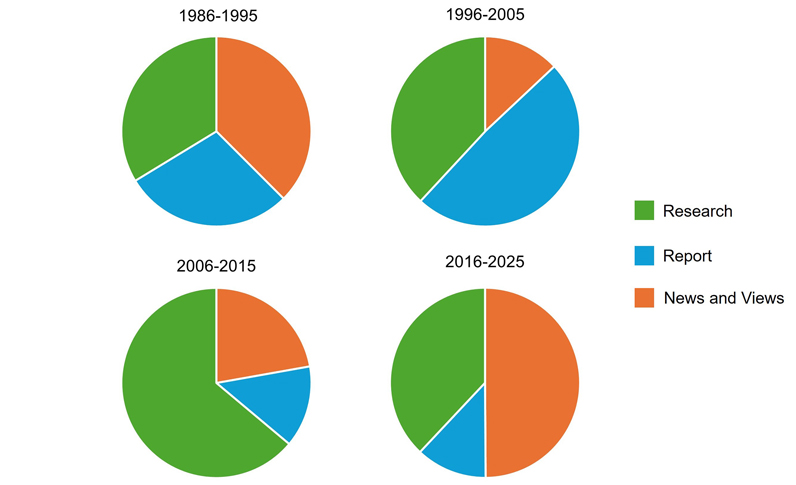
Figure 5: Percentage contribution of research, report and news and views article types across 4 decades.
Themed editions first appear in 1991
Themed editions place attention on topics of strategic, policy or industry relevance (Table 4). The first themed edition appeared in The Macedon Digest in 1991 on ‘Disaster Health and Medicine’ to acknowledge World Health Day. Articles explored infectious diseases, triage, rapid response medical capability for remote areas, medical disaster exercises, the NSW MedPlan and the health implications of climate change. Other themed editions of the journal have punctuated the emergency management knowledge-scape, reflecting on and advancing significant topics of relevance to the sector. Early themed issues about animals highlighted biosecurity and disease threats, while more recent animal-themed issues focused on the systems of care and relationships between people and animals in emergencies and disasters. Themed issues on resilience, volunteering, community safety, children and youth participation in disaster risk reduction, emergency law, gender and inclusion, forecasting and warnings and First Nations perspectives have generated thought leadership to accompany sector change. While articles on these topics are published in regular issues, themed issues galvanise critical attention on areas where research and practice knowledge has matured sufficiently to sustain policy and practice change or highlight topics of emerging significance for the emergency management sector.
Table 2: Hazard types covered in all published articles between 1986 and 2025.+++
| Year | Volume | Issue | Special issue topic |
| 1991 | 6 | 1 | Disaster health and medicine |
| 1991 | 6 | 4 | Earthquake |
| 1993 | 8 | 1 | Exotic animal disease |
| 1994 | 9 | 1 | Public health disasters |
| 1995 | 10 | 2 | International Decade for Natural Disaster Reduction |
| 2002 | 17 | 3 | Training |
| 2003 | 18 | 2 | Mass emergencies and disasters |
| 2003 | 18 | 2 | Recovery |
| 2003 | 18 | 3 | Vulnerability |
| 2003 | 18 | 4 | Volunteers |
| 2004 | 19 | 3 | Australian agriculture - securing the future |
| 2004 | 19 | 4 | Recovery |
| 2005 | 20 | 2 | Counter terrorism |
| 2005 | 20 | 4 | Volunteering |
| 2006 | 21 | 1 | AJEM 20th anniversary |
| 2006 | 22 | 2 | Community safety |
| 2008 | 23 | 3 | Crisis communications |
| 2010 | 25 | 2 | Resilience |
| 2012 | 27 | 2 | Policy and law in disasters |
| 2012 | 27 | 4 | New Zealand Earthquake |
| 2013 | 28 | 2 | Gender and disasters |
| 2014 | 29 | 1 | Youth, children and education |
| 2015 | 30 | 2 | Animals in emergencies |
| 2020 | 35 | 2 | Children and youth in disaster risk reduction |
| 2021 | 36 | 1 | Forecasting and warnings |
| 2021 | 36 | 3 | Animals in emergencies |
| 2021 | 37 | 1 | Gender justice |
| 2024 | 39 | 2 | Animals in emergencies |
| 2024 | 39 | 3 | Gender and diversity inclusion |
| 2025 | 40 | 2 | First Nations perspectives |
Conclusion: looking back, looking forward
Over 4 decades, the Australian emergency management sector has progressed through eras of civil defence, counter disaster and emergency management (Handmer 2026). Notions of PPRR, evidence-led decision-making, adaptive organisations, disaster risk reduction, disaster resilience, compounding disasters, community-centered preparation and recovery, technological change, diversity and inclusion and climate change have become normative settings for the policy and practice of emergency management. The Macedon Digest and AJEM have paralleled this sector progression and settings with a formal knowledge record.
This analysis of 1,755 articles over 4 decades shows how original research, reports of practices, projects, programs, incidents and policies and news about programs, policies, professional activity and events persistently occur alongside each other to frame advances and activity in the sector and to develop an applied knowledge record. All-hazards are the focus of the majority of articles, but different types of hazards come in (and out) of focus in response to disaster events and policy/programmatic or organisational change.
Management dominates article titles but implies management in service of agency mandates (incident management, organisational management, lessons management), community needs (recovery management) or risk reduction (floodplain management, land management). The gender of authors is also reflective of major shifts in the inclusion of women within the emergency management and research sectors since 1986. Many of the themed edition topics, while novel and innovative at the time, have become mainstream elements of policy and practice (e.g. animals in emergencies, volunteering, forecasting and warnings).
As with many public-facing sectors, emergency management is encountering increasingly dynamic and complex policy, organisational and operational environments, community expectations and resource settings. The complexity of the sector is radically different in 2026 than it was in 1986 when The Macedon Digest newsletter met a perceived need for information about meetings, training activities, research and local and overseas events in the pre-internet world. The transformation from newsletter to a hybrid industry-research publication has actively recorded, or influenced, scholarly, practice and functional transitions (e.g. Richardson 2026a,b).
The ways that AJEM supports the emergency management sector with research, evidence, insight and knowledge in the coming 4 decades will require continuing attention to the needs of the sector, the diversity of legitimate production of knowledge by different actors, standards of scholarly research and practice reporting and interaction with readers in meaningful and beneficial ways. Upcoming challenges to the placement of AJEM include: demands for integrated systems thinking across sectors, hazard types, communities and institutions; the emergence of artificial intelligence tools as activators of knowledge generation and access but also as sources for examined epistemic responsibility and ethical criticality; and the capture of potential state change in the severity and impacts of some types of climate-influenced natural hazards.
This analysis of articles over the last 40 years suggests some elements of the journal persist, while others change markedly. AJEM’s persistence and change have both intrinsic and extrinsic drivers, leading change and recording change as it occurs. If the future will not be like the past, the responsibility to guide AJEM readers through the next 40 years of research and practice in the emergency management sector will be a satisfying and stimulating journey.