

 Author
Jori P. Kalkman
Reviewed by
Dr Greg Penney
Charles Sturt University
Published by
Cambridge University Press
ISBN: 9781009262170
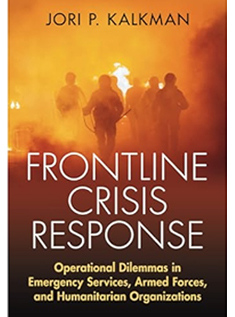
In Frontline Crisis Response, Jori Kalkman, an Associate Professor at the Netherlands Defence Academy, explores emergency service and military frontline response to uncertain and disorderly situations that temporarily destabilise power relations and impede centralised control over operational responders. A detailed and broad review of crisis response, guided by the author’s findings from previous research, the book takes a somewhat different perspective to sense-making, complexity and coordination of crisis response than other established approaches of Australian and some international, military and emergency services. In doing so, the book provides alternate perspectives that can assist frontline personnel and decision-makers to expand their thinking with respect to this critical field.
Kalkman defines ‘crisis’ as any situation that is characterised by a physical threat, uncertainty and time pressure. Through this lens, he explores the effects and management of crisis to first responders and people at a tactical or operational level while also discussing concepts of incident and emergency management. Written in a similar style to Paul Grimwood’s, Euro Firefighter 2: Firefighting Tactics and Fire Engineer's Handbook, Kalkman uses extensive references and supported citations that allow the reader to further explore concepts and arguments. At the same time, the text provides summary lessons and points for reflection at the end of each chapter that can assist educators and practitioners alike.
Readers of the text should approach it with an open mind and should not expect to see references to Endsley, Boyd or Snowden. Instead, readers are presented with ‘adjacent’ perspectives and views on situation awareness, sense-making and the resolution of complexity. Readers from Australasian emergency services backgrounds should also expect discussion and thoughts that present somewhat different approaches to crisis management adopted in Australasian Inter-service Incident Management System (AIIMS), the Incident Command and Control System Plus (ICCS+), or Crisis Appreciation and Strategic Planning (CASP) protocols.
Overall, this book provides interesting perspectives on crisis response that can assist readers familiar with Australasian emergency management practices to reflect on the subject using a different lens.