

Award winning practice: A history of Australia’s awards in the emergency management sector
The SCAs 'were developed to recognise and encourage "best practice" in emergency management, designed to keep Australian communities safe from disasters' (Emergency Services Minister Kevin Prince, WA Government 2000).
The SCAs received hundreds of entries from communities and organisations around Australia, and this submission pool reflects the changing nature of the disaster and emergency management sector. The review examined 350 available SCA entries from 2000–2010 to uncover shifts in practices and ideas over time.
In the 2000s, emergency management in Australia became more inclusive, embraced technology and moved to a systems-focused approach. Over time, the awards have evolved to prioritise knowledge sharing and now provide opportunities for projects to share learnings beyond the ceremony.
The SCAs became the RAAs in 2012. These new awards expanded submission scope from hazard mitigation to comprehensive resilience. A brief review of RAA submissions was also conducted to examine how the emergency management sector has evolved in the 21st century.
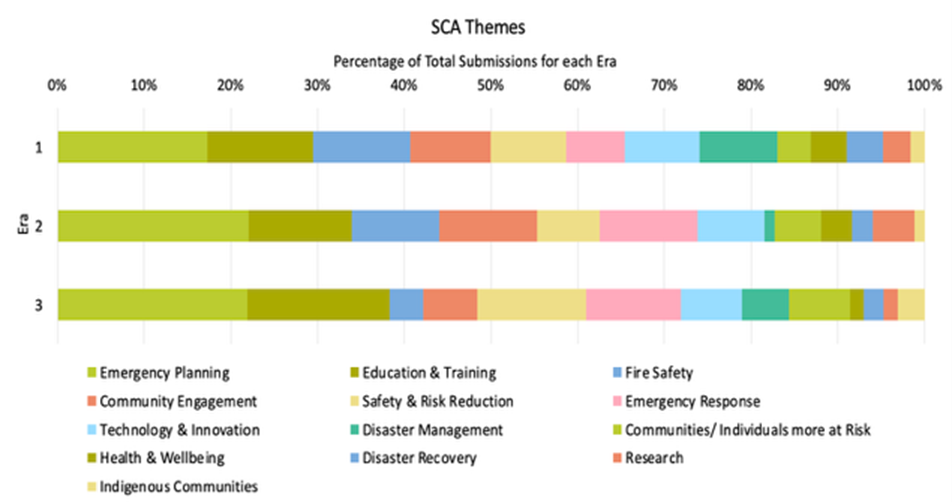
Figure 1: Distribution of common themes occurring in the total submissions for each era of the SCAs.
Key findings of the SCA review:
- SCA project entries evolved from hazard-specific programs and planning tools to more community-centred, inclusive and technology-enabled approaches.
- Award winners shared a common focus on emergency planning, community education and inter-agency cooperation and engagement.
- Winners also embraced new technologies and knowledge systems to improve early warnings systems, planning and communications.
- Dominant submission themes included emergency planning and community engagement
- Emergency plans became formalised, institutionalising existing processes already used in many communities
Notable submissions:
2000: Dubbo City Council Y2K Project
The council created a plan for Y2K which recognised the ending of the century beyond just an IT problem, but a problem that also included strong 'business risk issues'. The plan included a public awareness campaign, consulting emergency services, and provided assistance to local businesses. The plan was recognised globally for preparedness.
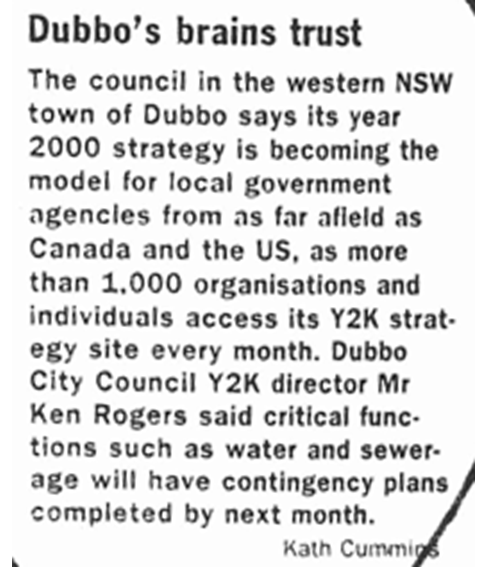
Excerpt from The Australian Financial Review, January 30-31, 1999.
2002: ‘Safe Country Stage II’ (FESA WA)
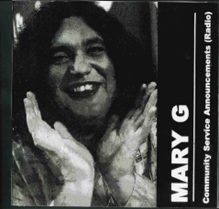
The project was made in consultation with Indigenous communities in the Pilbara and Kimberley regions to improve community safety messaging in a culturally sensitive way. The resulting project produced a three-part radio and TV program featuring the popular media personality 'Mary G', an alter ego of Mark Bin Barker, to improve Indigenous peoples understanding of the cyclone warning system and preparedness activities for the Wet season.
2008: ‘2007 National Triple Zero (000) Awareness Campaign’ (NSW Fire Brigade)
The first national public education campaign regarding the use of the Triple Zero phone line targeted children, culturally and linguistically diverse (CALD) communities, and Indigenous communities. Campaign materials were translated into 27 languages and distributed across mainstream, multicultural and Indigenous media channels.
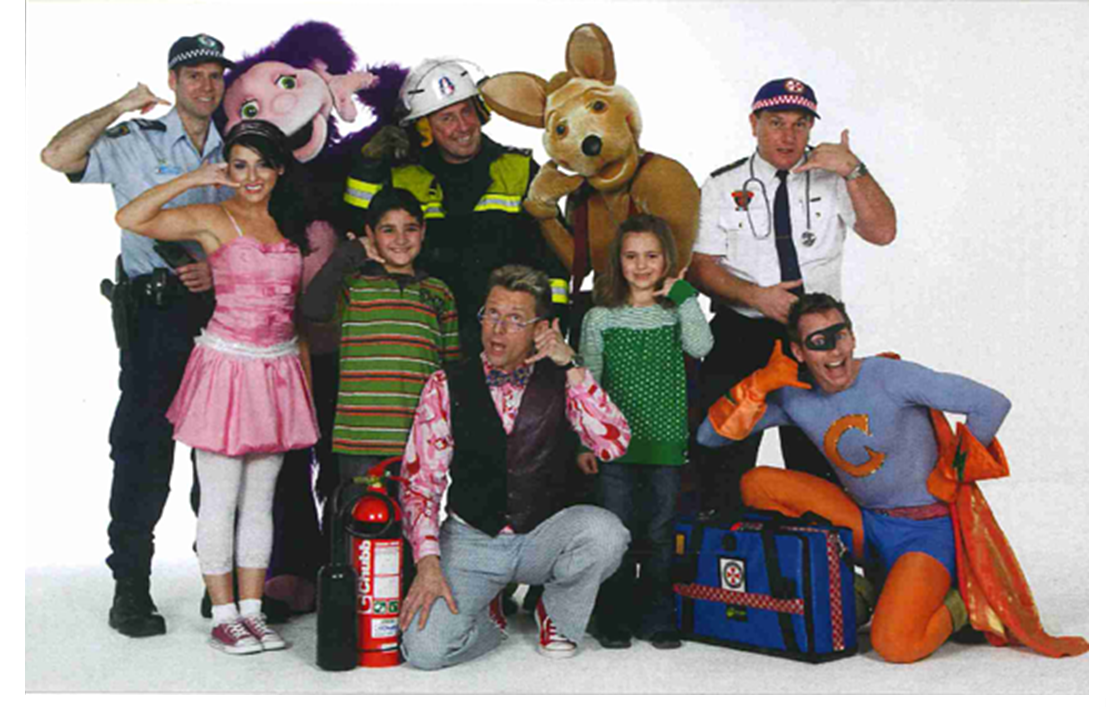
Advertising material for the National Triple Zero campaign in collaboration with the children’s performance group the Hooley Dooleys.
From the SCAs to the RAAs
- Climate change became more prominent in 2020s award submissions as Australia transitioned from reacting to disasters to anticipating and adapting to future risks and pressures.
- Technology use remained consistent but mostly declined in importance as it became embedded in the emergency management sector.
- Recovery transformed into resilience. Wellbeing was no longer siloed into post-event recovery; it was considered before, during, and after an event for all involved.
- Submissions changed from projects to systems. In the SCAs, projects were often local, hazard-specific and program-based. The RAA projects became more cross-sectoral, multi-hazard, and system-oriented. For example, many projects in the SCAs aimed to increase fire safety, whereas in the RAAs resilience strategies incorporated climate adaptation and increasing community capability.
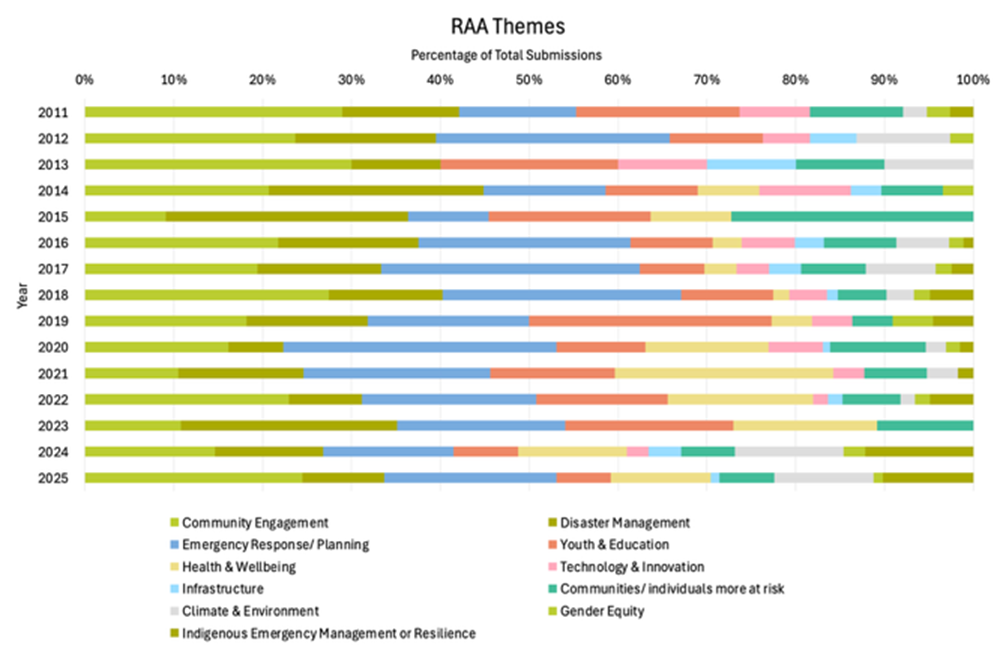
Figure 2: Distribution of Themes for the RAAs from 2011 – 2025
References
AIDR (2013). 2012 Resilient Australia Awards: building a disaster resilient Australia. Australian Journal of Emergency Management, 28 (1). https://knowledge.aidr.org.au/media/2304/ajem-28-01-12.pdf
COAG (2011). National Strategy for Disaster Resilience. https://www.homeaffairs.gov.au/emergency/files/national-strategy-disaster-resilience.pdf
Hodges, A. (1999). Beyond the International Decade. Australian Journal of Emergency Management, 14(4).
WA Government (2000). Margaret River Shire named a finalist in Safer Communities awards. Published 26th May 2000. https://www.wa.gov.au/government/media-statements/Court%20Coalition%20Government/Margaret-River-Shire-named-a-finalist-in-Safer-Communities-awards-20000526