

The winners of the 2025 Resilient Australia Awards were announced in Melbourne on 24 November, recognising recent efforts and new ideas that strengthen community resilience to disasters.
The 2025 Resilient Australia National Awards, sponsored by the Australian Government in partnership with the Australian Institute for Disaster Resilience (AIDR), spanned 10 categories including national, collaboration, research, business, community, government, mental health and wellbeing, and photography.
The celebrated projects included initiatives that protect Aboriginal cultural heritage, support young people’s wellbeing after floods, build local and tailored emergency plans, and get communities actively involved in flood preparedness and recovery.
John Richardson, AIDR Executive Director and event host, said the ceremony is a testament to the incredible work undertaken by organisations, individuals, and communities dedicated to making Australia more disaster resilient.
‘These are the unsung heroes – people working quietly in the background, often against the backdrop of bigger profiles, bigger budgets, and bigger priorities,’ he said.
‘Quietly, all of you are making progress to stop hazards from becoming disasters, so people can get on with their lives: watching their kids grow, celebrating milestones with family, working towards their goals, participating in society, tending their gardens and land, and creating practices that change lives.’
Andrew Minack, First Assistant Coordinator-General, Policy and Government at the National Emergency Management Agency (NEMA) emphasised the importance of community-led disaster resilience and the contributions of those driving these initiatives during his opening address.
Congratulations to all the finalists and winners of the National Resilient Australia Awards.
Resilient Australia National Award
Winner: Traditional Owners involvement in emergency management at the Gariwerd Complex and Little Desert fires – Department of Energy, Environment and Climate Action, Victoria
The 2024–25 bushfire season in the Grampians (Gariwerd) and Little Desert National Parks highlighted the urgent need to protect Aboriginal cultural heritage. The Grampians Complex fires, ignited by dry lightning, burned over 230,000 hectares, threatening natural, built, and sacred cultural landscapes of the Wotjobaluk Nations, Eastern Maar, and Gunditjmara Peoples. In response, the Cultural Heritage Unit was established within the incident management team, ensuring cultural values were integrated into all phases of the emergency response.
Key innovations included exclusion zones, thermal protection for significant trees, and manual vegetation removal around rock art sites. The Department of Energy, Environment and Climate Action’s submission emphasised the importance of Traditional Owner leadership and the need for cultural heritage protection in emergency responses.
Mr Richardson said this project brings the important issues of cultural heritage to the forefront and is an impactful and culturally led initiative.
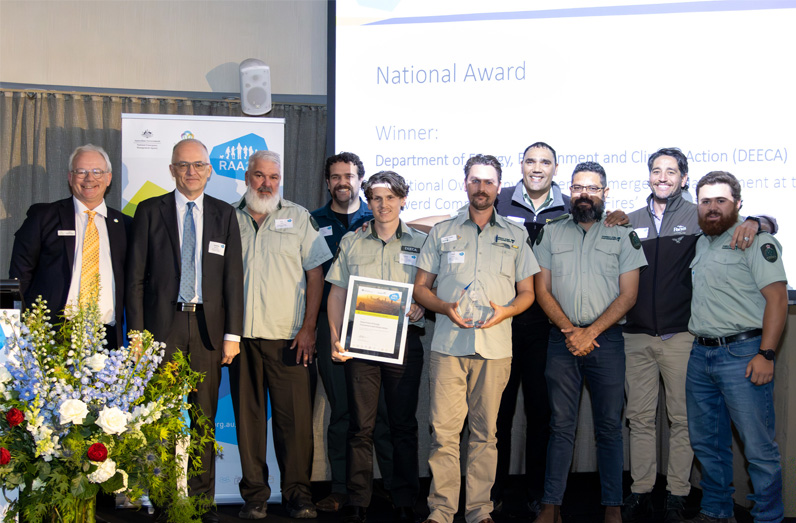
The Department of Energy, Environment and Climate Action, Victoria, was presented with the Resilient Australia National Award for their project, Traditional Owners involvement in Emergency Management at the Gariwerd Complex and Little Desert Fires.
Image: Emergency Management Victoria
Resilient Australia National Collaboration and Partnership Award
Winner: The Maribyrnong Insurance Project: Empowering communities to navigate flood insurance – Maribyrnong City Council, GenWest and Maribyrnong Community Recovery Committee, Victoria
In 2022, the Maribyrnong River flood caused extensive damage, displacement, and psychosocial impacts, with lengthy insurance and building repair processes leaving some residents unable to return home nearly 3 years later.
The Maribyrnong Insurance Project was a community-led initiative that made complex insurance information accessible.
In presenting the award, Mr Minack said that while these collaborations might have seemed obvious to internal project members, they demonstrate externally how bringing together 2 or more organisations can strengthen Australia’s resilience.
Resilient Australia National Research for Impact Award
Winner: Queering disasters: A new research, policy and practice paradigm – The University of Sydney and Western Sydney University, NSW
Since 2013, the ‘queering disasters’ program has delivered sustained, policy-focused research to address the previously overlooked risks and impacts of disasters on sexual and gender diverse people. This work has transformed global understanding, informed national queer-inclusive disaster risk reduction guidelines, influenced the United Nations’ approach, and established a new sub-discipline of queer disaster studies.
Through collaboration with community organisations, emergency management agencies, non-government organisations, and queer communities, the program has identified key needs and opportunities for more inclusive practice in the disaster management sector.
Professor Cheryl Desha, Science and Innovation Director at Natural Hazards Research Australia, said the award nominees displayed innovative, research-driven projects that demonstrate strong collaboration, inclusivity, and clear impact on disaster resilience.
Resilient Australia National Business Award
Winner: Building resilience from the ground up: Community emergency management planning – The Six C’s, Victoria
The Six C’s Community Emergency Management Planning program is a community-led model that helps local communities build practical and localised plans through a series of structure workshops, tailored to their needs, strengths and risks.
Since January 2023, it has been delivered across 10 Victorian communities who have now formed local disaster resilience groups and started identifying risks, assets, and actions. The program avoids a one-size-fits-all strategy while aligning with national disaster resilience frameworks. Its culturally aware co-design not only supports emergency management outcomes but also strengthens mental health, community cohesion, and long-term resilience.
Caitlin Zacharewicz, Manager of Workforce Volunteers and Community at Emergency Management Victoria, presented the award. She said the submissions showed a clear potential for scalability, sustainability, and creative engagement, making them valuable contributions to national resilience efforts.
Resilient Australia National Community Award
Winner: Community-led flood resilience on the Kurilpa Peninsula – Resilient Kurilpa, Queensland
Resilient Kurilpa (RK) is a community-led, volunteer-run disaster resilience network formed after the 2022 floods to strengthen flood preparedness, response, and recovery across Brisbane’s Kurilpa Peninsula. With support from the Australian and Queensland Governments, RK delivered a place-based program in 2023–24 that directly engaged more than 500 residents and reached thousands more online.
The project developed practical tools including a community-run flood website, an apartment toolkit, information sessions, workshops, blog articles, and a community-created trigger film to encourage apartment communities to take preparedness action. In total, RK’s activities reached 534 residents directly, alongside significant online engagement across its website, blog, webinars, and trigger film.
Faye Gibson, Senior Communications and Engagement Officer at Get Ready Queensland presented the award and said the finalists showcased exceptional creativity and inclusive, community-led approaches, delivering measurable impact and strong collaboration across sectors.
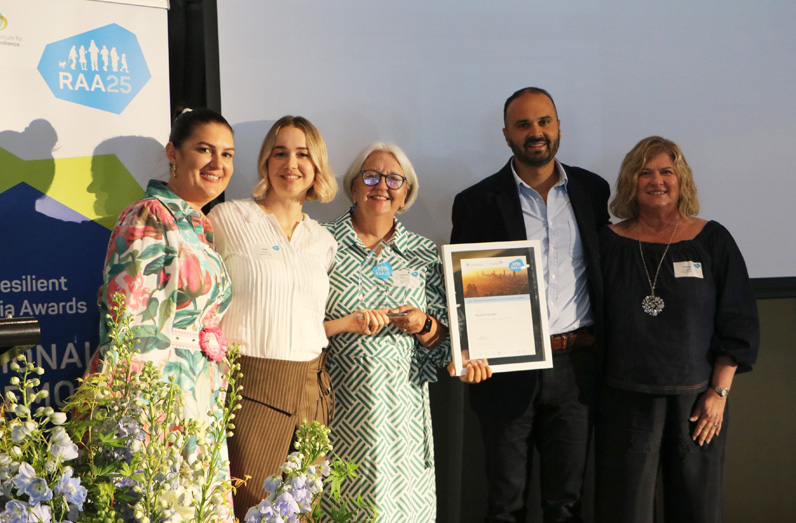
Resilient Kurilpa, was presented with the Resilient Australia Community Award for their project, Community-led Flood Resilience on the Kurilpa Pensinsula.
Image: Emergency Management Victoria
Resilient Australia National Government Award
The Resilient Australia National Government Award had 2 winners in 2025.
Winner: Australian first - Aboriginal Cultural Incident Management Exercise – NSW Department of Climate Change, Energy, the Environment and Water, Merrimans Local Aboriginal Land Council, NSW National Parks and Wildlife Service, NSW Crown Lands and NSW Rural Fire Service
The 2019–20 bushfires caused catastrophic damage across eastern Australia, including the loss of culturally significant Aboriginal sites. With most site knowledge held privately within Aboriginal communities, there has been no culturally safe way to share this information during emergency response.
To address this, the Applied Bushfire Science program, NSW Rural Fire Service, and NSW National Parks and Wildlife Service delivered a first-of-its-kind simulation exercise that brought Aboriginal rangers into the control room during a realistic bushfire scenario. This 2-way learning process showed how cultural knowledge can be safely integrated into real-time fire planning, establishing it as a vital component of emergency decision-making.
Winner: Traditional Owners involvement in emergency management at the Gariwerd Complex and Little Desert fires – Department of Energy, Environment and Climate Action, Victoria
The Department of Energy, Environment and Climate Action’s project won multiple awards during the Resilient Australia National Awards Ceremony in 2025. The project description is featured in the Resilient Australia National Award category.
Bridget Tehan, Senior Advisor, Humanitarian Diplomacy at Australian Red Cross, presented the award and said many initiatives showed promising scalability and sector-wide impact, with frameworks and evaluations in plan to support long-term success.
Resilient Australian National Local Government Award
Winner: The Maribyrnong Insurance Project: Empowering communities to navigate flood insurance - Maribyrnong City Council, GenWest and Maribyrnong Community Recovery Committee, Victoria
Maribyrnong City Council, GenWest and Maribyrnong Community Recovery Committee won multiple awards for their project during the Resilient Australia National Awards Ceremony in 2025. The project description is featured in Resilient Australia National Collaboration and Partnership Award category.
In presenting the award, Nadia Osman, Director of Emergency Management at the Australian Local Government Association, said all projects displayed strong co-design, inclusive community engagement, and cross-sector collaboration to deliver tangible outcomes and improve disaster preparedness.
Resilient Australia National Mental Health and Wellbeing Award
Winner: Resilient Kids: Empowered young people can weather life’s biggest storms – Social Futures, NSW.
Resilient Kids is a youth-centred mental health and wellbeing program created in response to the 2022 Northern NSW floods to support young people aged 8-18 in their recovery and build long-term disaster resilience. The program was co-designed with young people, families, and local services, and provides tailored therapeutic support, resilience tools, and creative engagement activities across the Northern Rivers.
Led by Social Futures with partner organisations, the 2-year program has already supported thousands of young people and caregivers through flexible Wellbeing Hubs and outreach to rural communities. It is described as an ‘ecosystem of support’, and offers a scalable, inclusive model for disaster recovery that is timely, youth-driven, and impactful.
Rob Webb, CEO of AFAC (the Australian and New Zealand National Council for Fire and Emergency Services), presented this award which was one of 7 submissions.
Resilient Australia National School Award
Winner: Our River – Richmond Agricultural Centre: Centre of Excellence in Agricultural Education, NSW
Our River is a school-based flood awareness and wellbeing program delivered across the Hawkesbury–Nepean Catchment since 2022. Initially run by the Centre and expanded in 2024 through a partnership with NSW Reconstruction, the program helps primary and secondary students understand the science and history of floods, build preparedness skills, and reconnect positively with the river after disaster events.
The 2024 expansion introduced a stronger focus on preparedness, student-led Hackathons, and an Indigenous communication program, with the initiative widely embraced by schools across the valley.
Laura Cooper, National Resilient Australia Awards Judge, presented the award and said it was ‘truly inspirational’ to see all the work that is being delivered.
Resilient Australia National Photography Award
Winner: Protecting Country Together – Department of Energy, Environment and Climate Action’s Cultural Heritage Advisory Committee, Victoria
The winning photograph demonstrates disaster resilience through the proactive and culturally informed efforts to protect irreplaceable Aboriginal rock art from bushfire damage. It shows Traditional Owners and representatives from all 3 registered Aboriginal parties working alongside agencies on Country, applying cultural knowledge and rapid response strategies to reduce the impact of fire on significant heritage sites.
Rather than reacting after damage occurs, this coordinated effort represents resilience through preparation, collaboration, and cultural leadership, protecting not only the physical sites, but also the stories, identity, and connection they hold.
Joanna Wood Freeman, Communications Manager at Natural Hazards Research Australia, presented the award. There was a total of 23 photos submitted.
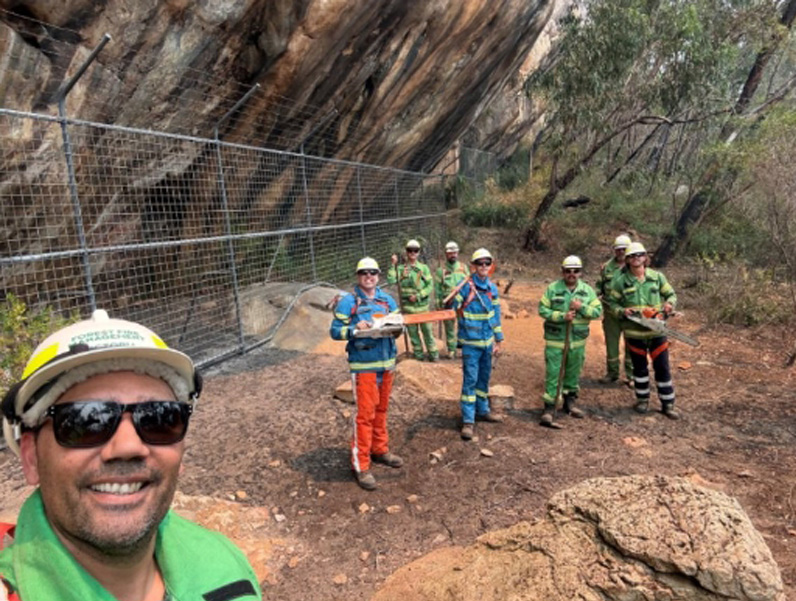
The winning photograph demonstrates disaster resilience through the proactive and culturally informed efforts to protect irreplaceable Aboriginal rock art from bushfire damage.
Image: Department of Energy, Environment and Climate Action’s Cultural Heritage Advisory Committee
The Resilient Australia Awards program was launched in 2000, and AIDR has proudly run the program on behalf of the Australian Government since 2017. The Resilient Australia Awards are hosted by the AIDR and sponsored by the Australian Government in partnership with the states and territories. Submissions to the 2026 Resilient Australia Awards program will open in March 2026.