

 In 2026, AJEM celebrates an important milestone – 40 years of publication. Readers may or may not remember 1986, but Bob Hawke was Prime Minister; Bananarama, Madonna and Paul Kelly were at the top of the music charts; and Top Gun and Crocodile Dundee were on at the movies. The World Wide Web was not yet invented and mobile phones weighed 4 kg. Much has changed since then. Where we live, how we live, how many of us there are, how we interact with each other and the environment, and what we value. But, like Madonna and Paul Kelly, some things persist over 40 years. Bushfires, floods, cyclones, storms, earthquakes, drought, heatwave and coastal erosion have always occurred and will continue to occur in Australia. Disasters that arise at the intersection of people and natural hazards cause great loss, trauma and disruption. This reminds us of the constant need for shared readiness and resilience.
In 1986 Australia was still recovering from the 1983 Ash Wednesday bushfires in one of the most significant shifts in emergency management from civil defence coming out of the war years to domestic hazard protection. The Civil Defence School, established in 1956, had been reconfigured into the Australian Counter Disaster College in 1978 to develop counter-disaster capability by fostering understanding and cooperation between communities and by understanding research into
disasters. In 1993, the college became the Australian Emergency Management Institute (AEMI) in response to the huge importance of applied research, training, resilience and shared knowledge in emergency management. AEMI played a vital role to help prepare Australia for the many challenges it would face in hazard identification, preparedness and response in the years ahead.
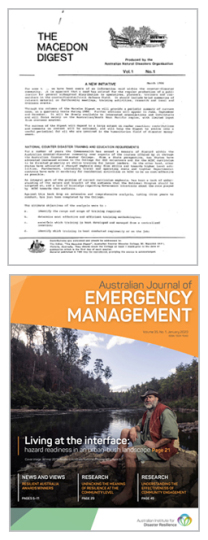
From its beginning, AJEM has been a source of knowledge for emergency services and related practitioners, researchers, policy makers and industry. AJEM was first published as a 6-page newsletter in March 1986 as 'The Macedon Digest' to fill an information void within the counter-disaster community. In 1988, it was recast as the 'Australian Newsletter of Disaster Management' and the journal doubled in size as research became more valuable to the sector. In 1995, the publication was registered as the Australian Journal of Emergency Management that we know today.
AJEM has changed over the years but still delivers practice-based evidence and knowledge. AJEM focuses on promoting and facilitating evidence, discussion and debate at all levels of emergency management. Peer-reviewed research papers, practice reports and other articles co-exist within each issue, documenting the evolution of knowledge, public policy and practice. Academic in its rigour and practical in its use, AJEM remains a trusted and authoritative body of knowledge.
Across 2026, AJEM will review its 40-year legacy by looking back and forward at changes, challenges, achievements and progression of emergency and disaster management. Each issue will contain 40th anniversary content and we invite you to reflect on 40 years of progress in disaster and emergency management.
This issue includes a recap of AJEM’s first decade [1986 to 1996] and reflections by readers on influential past papers. An interview with a past Macedon Digest contributor shares reflections on their published work and offer directions for the future of AJEM. Sitting alongside research papers and other content, this anniversary year is a time to highlight the critical contribution that AJEM has had and continues to have as an accredited and trusted source of evidence and practice knowledge.