

 Author
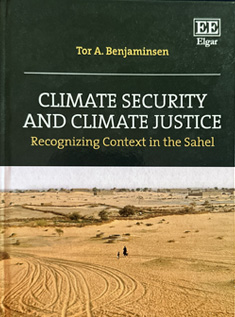
Tor A. Benjaminsen
Reviewed by
David King
Published by
Edward Elgar
ISBN: ISBN 978 1 0353 2517 7 (cased)
ISBN: 978 1 0353 2518 4 (eBook)
Benjaminsen explores the complex interplay between climate change, security and justice in the Sahel region of West Africa. He emphasises the importance of understanding historical, political and environmental contexts. There are 2 broad issues in the title of this book: climate justice, where climate change is ostensibly the primary agenda, and climate security. The issue of security is about the decline in security brought about by conflict, alongside international migration; both allegedly prompted by climate change. Injustice concerns the unfairness for people who may be the most affected by climate change; very often being the least responsible for causing it.
In terms of the security issue, climate change might be a tipping point for many communities and societies, but inequality between rich and poor is the underlying cause of conflict. The historical and political context goes further in explaining security and justice issues than a narrow focus on climate change as an explanation. The background context derives from colonialism, which drove inequality, oppression and dispossession of land that led to rebellion, secession and civil war with many rebel groups, especially those of Muslim societies, being labelled as terrorists. This spills over into migration, which is primarily driven by greater opportunities elsewhere in the world. On the political side, poor governance is a consequence of colonial regimes whereby precolonial social and political systems were dismantled resulting in a post-colonial legacy of poorly resourced and poorly prepared leaders who inherited alien regimes.
Although this book focuses on a very remote location, it is a striking example of climate change injustice that affects many parts of the developing world. The Sahelian crisis has been characterised by droughts, famines and violent conflicts; often exacerbated by climate change. Current interpretations blame these issues primarily on environmental factors, neglecting the political and historical dimensions of the crisis. Colonialism, state policies and land dispossession have shaped the current situation. The book goes into the history of the idea of desertification; the southward advance of the Sahara Desert. This view has persisted despite scientific evidence showing a greening of the Sahel in recent decades. Desertification was identified in colonial times when local populations were blamed for environmental degradation. Large-scale afforestation projects like the Great Green Wall (a line of trees planned to go across Africa from the Atlantic to the Red Sea) and similar schemes that target carbon sequestration result in land dispossession and increased conflicts that particularly affect pastoralists. Pastoralism is highly adaptable to climatic variability, but state policies have, historically, marginalised pastoralists, leading to land conflicts and grievances. This fuelled the rise of jihadist groups that attract support by addressing issues of social justice and poor governance.
Threats to subsistence drive uprisings that are often misinterpreted as purely religious or ethnic conflicts. The Tuaregs are desert pastoralists who interact with the Sahel, while the Fulani graze cattle across the dry lands throughout West Africa. Both cultures are deeply Islamic and marginal to mainstream settled societies. It is their traditional grazing land that has been targeted as marginal and degraded as an excuse to take it over for both commercial irrigated agriculture and for carbon trading schemes. Their consequent rebellions have been portrayed as fundamentalist Jihadist terrorism.
This case study is applicable to many parts of the less-developed world where understanding historical and political issues, especially the disruptions of European colonialism, more fully explain the background to conflict and environmental stress than a narrow attribution of climate change as the primary driver of crisis. This book warns against placing the burden of climate change mitigation on the poorer societies of the world.